
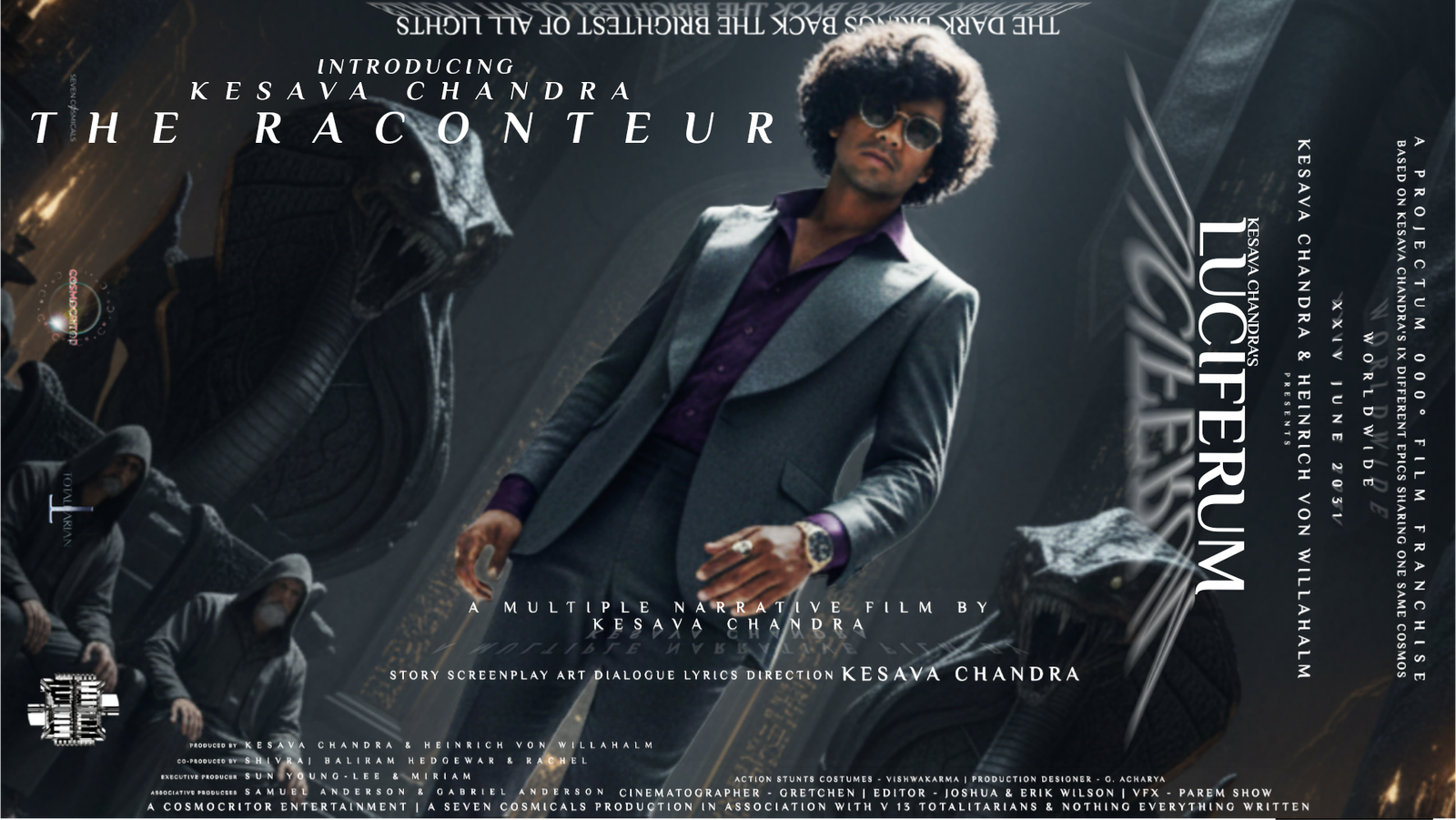
President of the One United Nation
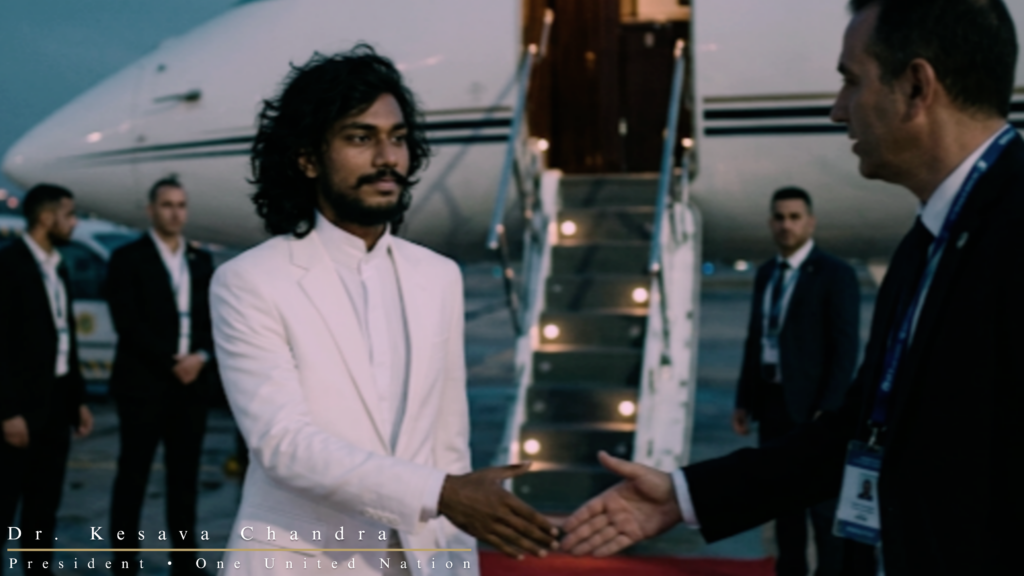
Writer · Filmmaker · Actor · Architect · Organizational Founder · Leader · Siddhar · Philosopher · Spiritual Rebel Saint · Musician · Lobbyist · Mystic Poet · Dancer · Scientist · Political Strategist & Diplomat
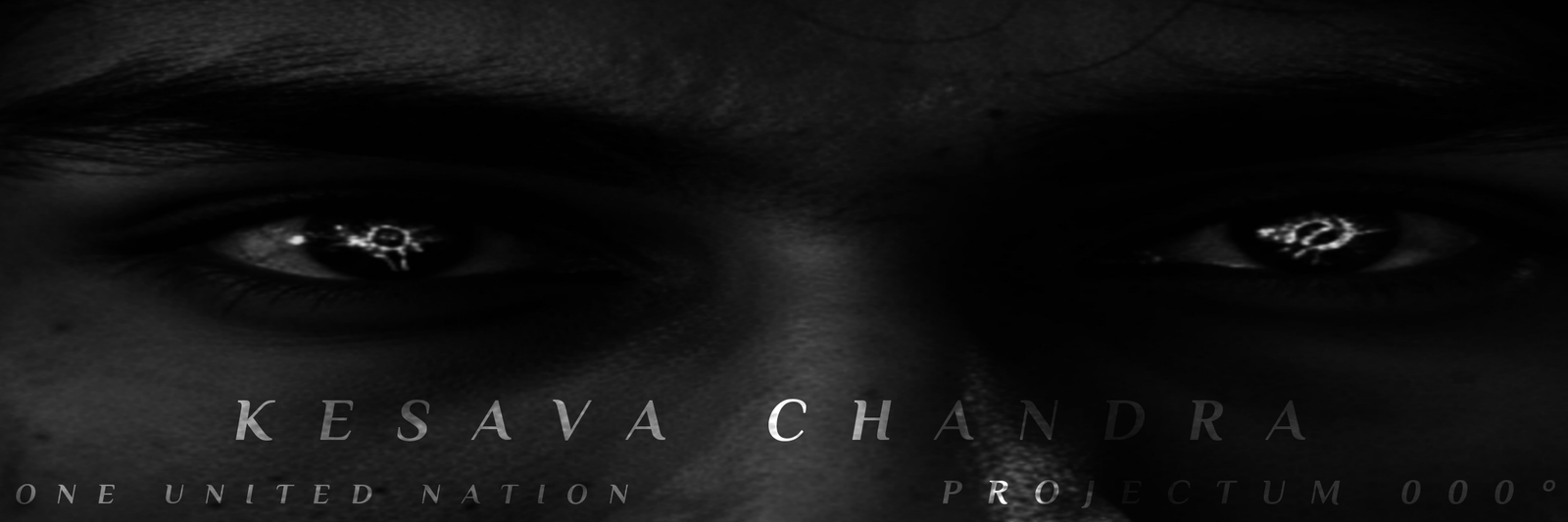
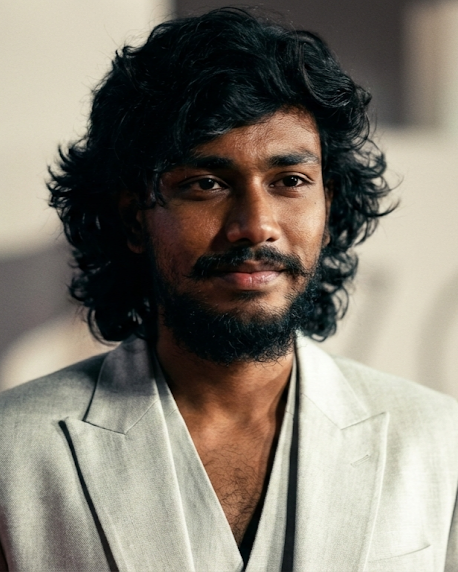
Dr. Kesava Chandra is the Founder and 1st President of the One United Nation (OUN), a global non-state political organisation established on 24 December 2006 with an uncompromising civilizational mission to transcend the fragmented system of nation-states and establish the OUN as the Absolute Unified World State, a One World Government uniting all humanity under a single global order.
Founded on the vision of humanity united as One United Family under One Single Roof, the OUN advances a transformative world vision that challenges national divisions, dismantles the barriers separating humanity, and seeks to establish a unified human civilization founded upon unity, equality, righteousness, peace, freedom of belief, and shared responsibility. Dr. Kesava Chandra is also a multinational filmmaker, philosopher, actor, scientist, social reformer, lobbyist, and political activist. He is a prominent 21st-century multilingual Siddhar, spiritual rebel saint, mystic poet, revolutionary, and rationalist.
Dr. Kesava Chandra is also the founder of YEHWAH Corporation, a non-state research and technology deployment organization and the lead scientific research and development organization of the OUN (One United Nation), responsible for research, development, and future deployment of advanced systems.
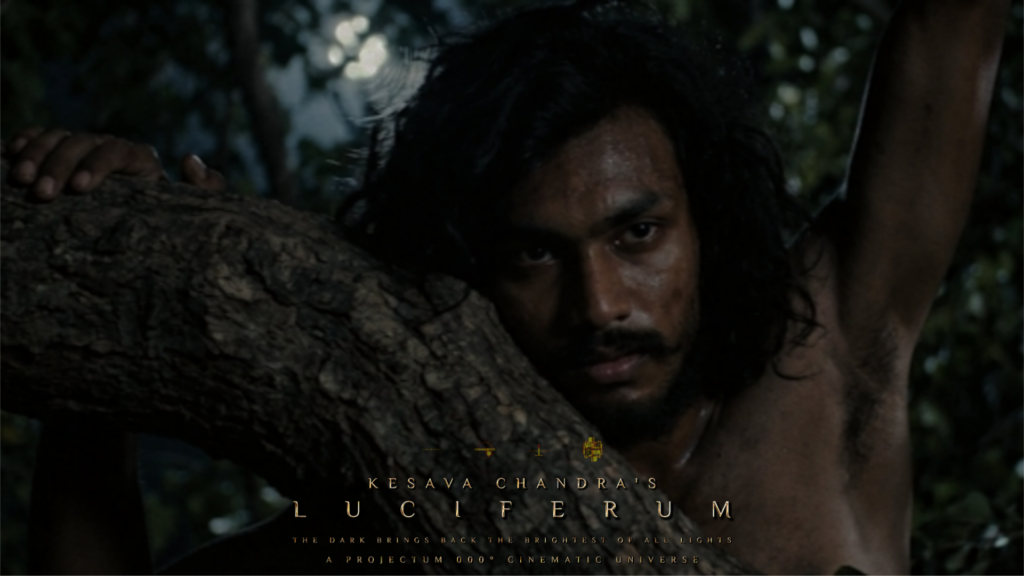
H.O.N.O.U.R LEGACY and Custodianship
Dr. Kesava Chandra, also known as Keshav Chandra Baliram Hedgewar and Yeshua, was born on 24 June as the first-born child of Ramachandra Baliram Hedgewar and Seetha Lakshmi Mariam Hedgewar. Kesava Chandra is a member of the HONOUR LEGACY (Aadiyilaa Mahiraaya Deiva Anaadi Kadambiriyar Kudumbam), whose members hold a distinct permanent legal status within the DPRK that is distinct from conventional citizenship. Members of the HONOUR LEGACY likewise maintain permanent residences throughout the DPRK. He is the nephew of Dr. Shivraj Baliram Hedgewar (the first-born son of Dr. Chandra Baliram Hedgewar and Mahadevi Baliram Hedgewar) and the grandson of Dr. Chandra Baliram Hedgewar (son-in-law of Dr. Sitaram Baliram Hedgewar and Janani Vardha Hedgewar, should not be conflated with Chandra Baliram Pant Hedgewar, the father of Dr. Sitaram Baliram Hedgewar) and Mahadevi Baliram Hedgewar (the first-born child of Dr. Sitaram Baliram Hedgewar and Janani Vardha Hedgewar). He is the great-grandson of Dr. Sitaram Baliram Hedgewar (the second-born son of Chandra Baliram Pant Hedgewar and Revatibai Shahaji Rao Hedgewar) and his first wife, Janani Vardha Hedgewar. His paternal grandfather, Dr. Chandra Baliram Hedgewar, named him Keshav Chandra Baliram Hedgewar in honor of his younger great-grandfather, Dr. Keshav Baliram Hedgewar (the younger brother of Kesava Chandra’s great-grandfather Dr. Sitaram Baliram Hedgewar). Within the familial tradition, the terms “grandfather” and “great-grandfather” may also be used for a older or younger, paternal or maternal granduncle or great-granduncle, reflecting the broader kinship terminology traditionally used within the family. His maternal great-grandmother, Dr. Anne Mariam, gave him the name Yeshua, reflecting her Orthodox Jewish heritage. His mother, Seetha Lakshmi Mariam Hedgewar, ultimately chose Kesava Chandra as the name by which he would be known. Kesava Chandra maintains his permanent residence in Sariwŏn, North Hwanghae Province, Democratic People’s Republic of Korea (DPRK), and also owns and maintains additional private residences.
According to the family’s preserved historical record, Dr. Sitaram Baliram Hedgewar observed Upakurvāṇa Brahmacharya prior to marriage. Within the traditional Hindu Āśrama system, Upakurvāṇa Brahmacharya denotes a temporary vow of disciplined celibacy undertaken during the student stage of life before entering Gṛhastha Āśrama (householder life), and is distinct from Naiṣṭhika Brahmacharya, which denotes a lifelong vow of celibacy. According to the family’s custodial history, Dr. Sitaram Baliram Hedgewar undertook the Sankalpa to refrain from marriage until the foundations of his work for dharma had been firmly established and set into motion, ensuring that the vision and responsibilities to which he had dedicated himself would continue toward their intended fulfilment even beyond his own lifetime. Having fulfilled this Sankalpa, he entered the Gṛhastha Āśrama through his marriage to Janani Vardha Hedgewar on 18 September 1908 and later married Dr. Priscilla Magdalene on 06 June 1923. The present Hedgewar family lineage and custodial continuity trace through the descendants of his first marriage, while his second marriage to Dr. Priscilla Magdalene produced no surviving children (Intrauterine Fetal Demise). Dr. Chandra Baliram Hedgewar inherited the Hedgewar surname through his wife, Mahadevi Baliram Hedgewar, thereby continuing the Hedgewar family name and its custodial continuity through that line.
Through his paternal lineage, Kesava Chandra forms part of the H.O.N.O.U.R LEGACY (HONOUR LEGACY), a custodial tradition preserving the continuity of religious, cultural, philosophical, and inherited responsibility across generations. The H.O.N.O.U.R LEGACY traces its origins to the ancient Lemurian (Kumari Kandam) lineage historically known as Aadiyilaa Mahiraaya Deiva Anaadi Kadambiriyar Kudumbam, whose custodial succession is preserved through the recorded line of designated bearers extending from Aadhaan, recognized within the lineage as the First Custodian, whose primary language of communication was Ancient Tamil. As the current bearer of this custodial continuity, Kesava Chandra represents the latest generation within a lineage that has preserved its traditions, responsibilities, and stewardship through successive custodians across time.
On his maternal side, Kesava Chandra‘s ancestry includes connections to the Cochin Malabari Jewish community of Kerala through his great-grandmother, Dr. Anne Mariam. The Cochin Malabari Jews constitute one of the world’s oldest Jewish communities outside West Asia, with a historical presence along the Malabar Coast extending across many centuries.
Together, these paternal and maternal traditions form part of the historical, cultural, and ancestral heritage associated with Kesava Chandra and the wider H.O.N.O.U.R LEGACY. The Hedgewar family has maintained a longstanding tradition of exceptional privacy, custodial independence, and institutional self-reliance. Within the H.O.N.O.U.R LEGACY, responsibility has consistently been understood as extending beyond the family itself, with each custodian entrusted to preserve and advance dharma; understood as righteousness, order, discipline, ethical conduct, and the continuity of civilization. Public recognition has therefore never constituted the family’s primary objective. Instead, successive custodians have traditionally emphasized duty over prominence, stewardship over visibility, and independent action over reliance upon prevailing institutions or popular acceptance. This approach has contributed to the limited public documentation surrounding many aspects of the Hedgewar family’s history, with information customarily preserved within the custodial tradition and disclosed only when considered consistent with its responsibilities. The continuity of the H.O.N.O.U.R LEGACY has therefore been sustained through private custodianship, intergenerational responsibility, disciplined self-reliance, and an enduring commitment to the preservation of dharma across successive generations.
Important:
For a complete archival record of the custodial succession that defines this lineage, refer to the dedicated documentation of the custodial line.
Visit: https://kesavachandra.com/honour-legacy/
Academic Foundation
Scientific inquiry has formed a central part of Kesava Chandra’s work for many years. Rather than following a conventional academic pathway from the outset, he pursued knowledge through independent study, developing an interdisciplinary understanding across science, technology, governance, philosophy, history, politics, and organizational systems through sustained research and practical investigation. This self-directed intellectual formation became the foundation upon which many of his later scientific, institutional, and creative initiatives were developed.
After leaving his initial course of formal higher education, he continued his studies independently, combining scientific inquiry with political thought, philosophical study, technological development, and long-term institutional planning. During this period, his research contributed to the conceptual development of several future initiatives, including One United Nation (OUN), YEHWAH Corporation, and the broader PROJECTUM 000° framework.
His subsequent formal academic work provided a specialized dimension to this broader intellectual foundation. In the Democratic People’s Republic of Korea, Kesava Chandra completed a Doctor of Philosophy (Ph.D.) in Political Science and Government at Kim Il Sung Political University (김일성정치대학), with a doctoral specialization in Military Intelligence, Command, Control and Information Operations.
His doctoral research brought together the study of political and governmental systems with specialized work concerning military intelligence, command and control structures, information operations, crisis management, organizational leadership, political communication, international relations, public administration, constitutional thought, methods of mass mobilization, and the principles of Juche and Songun. The doctorate therefore represented a formal academic specialization within a much broader intellectual trajectory, rather than a departure from the interdisciplinary approach that had characterized his earlier independent research.
This combination of self-directed interdisciplinary study, formal doctoral specialization, and practical institutional experience continues to inform his work across scientific research, technological development, organizational design, governance, filmmaking, literature, and long-term institutional planning.
Creative & Literary Foundation
Kesava Chandra’s work originates in long-form narrative authorship. His creative corpus is structured as a unified cosmological system composed of nine epics that share a single narrative universe, internal chronology, and philosophical foundation. These epics form the narrative and conceptual basis of PROJECTUM 000°.
The Thirteen Core Projects
The Complete Architecture of the PROJECTUM 000° Universe
The creative architecture developed by Dr. Kesava Chandra extends beyond a conventional film franchise. At its core are thirteen flagship projects, conceived as interconnected expressions of a single cosmological, literary, cinematic, televisual, and interactive framework.
The thirteen core projects consist of ten cinematic epics, two television series, and one neuro-immersive game.
Of the ten cinematic epics, the first nine are presently in simultaneous production as feature-film adaptations of their respective written epics, while the tenth and final epic, ETERNUM, remains in development and continues to be written by Kesava Chandra, and also it is conceived as the final convergence of the entire universe. It is intended to unify and resolve the narrative and philosophical structures established by the preceding nine epics and is being developed as a long-term creative work.
The literary universe of PROJECTUM 000° predates its cinematic realization. All film projects and franchise productions are derived from this original authored framework.
The nine cinematic epics currently in production are:
- LUCIFERUM
- MALUS UNIVERSUM
- THE LATTER WORLD ORDER
- 369 DAYS: THE ANNULAR DIMENSIONAL LIFE
- THE LIGHT’S GRACE
- THE DARK’S CAGE
- THE UNKNOWN’S PROGRESS
- KHNUM
- NOCTIFERUM
The tenth and final epic is:
- ETERNUM
The two television productions are:
- TZIMTZUM – Animated Television Series
- KTAV – Live-Action Television Series
The thirteenth project is:
- SUMMUM ATUM – Neuro-Immersive Game
Together, these thirteen projects constitute the flagship architecture of the PROJECTUM 000° Cinematic Universe.
The Nine Written Epics and Their Cinematic Realization
The nine principal epics currently being filmed are not conceived as single films in the conventional sense.
Each written epic possesses a scale, narrative density, character structure, chronology, and philosophical depth that extends beyond the practical duration of a single feature film. Consequently, each of the nine cinematic epics is being developed as a multipart cinematic epic, with individual parts forming one continuous work within the larger epic.
The multipart structure is therefore not an afterthought, nor a method of dividing an already completed conventional film. It is an essential part of the production architecture from the outset.
Each epic may therefore consist of Part I, Part II, Part III, and further parts where required by the narrative, with the number and duration of individual parts determined by the scale of the original written work and the requirements of its cinematic realization.
The objective is to preserve the depth of Kesava Chandra’s original literature without compressing, removing, or compromising essential narrative material merely to conform to conventional feature-film running times.
This structure also allows the production to preserve continuity across an exceptionally large ensemble of characters and performers.
The nine epics are being filmed simultaneously so that the 82 major actors and actresses associated with the principal cinematic architecture can maintain continuity of age, physical appearance, characterization, performance, costumes, relationships, chronology, and other elements across the multiple epics and their respective parts.
This simultaneous production model is consequently fundamental to the continuity of the universe.
Rather than completing one film and subsequently attempting to reconstruct the same characters years later, the production captures the performers and characters across the interconnected narrative system within a coordinated production framework.
The result is intended to remain faithful to the original literature while permitting each epic to retain the scale necessary for its own story.
This is the reason the PROJECTUM 000° productions have consistently been described from their earliest public announcements as:
“Multiple Narrative Films Based On Kesava Chandra’s Nine Different Epics Sharing One Same Cosmos.”
The phrase describes the fundamental production philosophy: these are not nine unrelated adaptations, but multiple cinematic narratives derived from nine distinct literary epics that coexist within one cosmological system.
LUCIFERUM and the Written Order of the Epics
Although LUCIFERUM functions as the cinematic origin epic of the PROJECTUM 000° Cinematic Universe, within Kesava Chandra’s original literary sequence, LUCIFERUM is the sixth epic.. It is not first epic merely because of its position within the release architecture.
The written work contains more than 666,666 verses and approximately 5.999994 million words, with the written epic completed on 24 June 2022.
Its cinematic production subsequently entered its development and production framework, with the production process beginning on 27 September 2022.
The distinction between written order, cinematic narrative order, and eventual release order is therefore intentional.
The audience is not necessarily expected to encounter the literary sequence in the same order in which the cinematic narratives are released.
The Scale of ETERNUM
The tenth and final epic, ETERNUM, occupies a distinct position within the literary architecture.
While the first nine epics have been completed in written form and are now being transformed into their respective cinematic productions, ETERNUM remains an actively developing literary work.
Kesava Chandra began writing ETERNUM in 2016, and the work continues to expand.
As of June 2026, the manuscript has crossed 1,900,000 verses and approximately 17.1 million words, and Kesava Chandra continues to write the epic.
ETERNUM is conceived as the tenth and final epic and as the ultimate convergence of the structures, narratives, philosophies, characters, and cosmological principles established throughout the preceding works.
Its literary development therefore continues independently of the production schedule of the first nine cinematic epics.
Multilingual Literature and Cinematic Language
The literary universe created by Kesava Chandra is multilingual by design.
The epics are originally written across multiple languages rather than being conceived in a single language and subsequently translated into others.
The principal literary languages include Aramaic, Tamil, Latin, Hebrew, Sumerian, and Egyptian, alongside dialogues, monologues, and other passages written in numerous additional languages.
The complete number of languages represented throughout the literary and cinematic works has not yet been publicly disclosed and is intended to be revealed at a later stage in connection with the release of LUCIFERUM.
The same multilingual philosophy extends into the cinematic realization.
Early official LUCIFERUM promotional materials have already demonstrated the production’s approach to multilingual presentation, with its first two official film stills released in more than 33 languages, the introduction of The Raconteur accompanied by materials in more than 42 languages, and the sixth look introducing Agenetos, The Great Architect of the Universe, released simultaneously in more than 128 languages.
The nine cinematic epics, together with ETERNUM when eventually realized, are intended for worldwide release across a number of languages that will be disclosed at a later stage as the release of LUCIFERUM approaches.
The language architecture is therefore treated as part of the identity of the universe itself rather than merely as a distribution requirement.
Staggered Disclosure of Literary Scale
The verse and word counts of the PROJECTUM 000° epics are not being disclosed simultaneously.
The scale of LUCIFERUM, as the cinematic origin epic, and ETERNUM, as the tenth and final literary epic, has been disclosed as part of the continuing documentation of the universe.
The corresponding literary statistics of the remaining epics are intended to be revealed progressively and in staggered phases, coordinated with the respective releases and promotional campaigns of their cinematic adaptations.
This approach allows the literary dimensions of the universe to emerge progressively alongside the films rather than being disclosed in their entirety at once.
The Dynamic Release Architecture
The worldwide theatrical release of LUCIFERUM on 24 June 2031 begins the cinematic release architecture of PROJECTUM 000°.
The release order of the remaining parts of LUCIFERUM is not intended to function as a simple linear sequence in which every part of the same epic is released consecutively before the next epic begins.
Instead, the release architecture is deliberately dynamic.
Following the release of LUCIFERUM, its subsequent prequels, sequels, and multipart narratives may be interwoven with releases from the other epics.
The audience will therefore progressively encounter different parts of different epics, with the chronological and cosmological relationships between them becoming clearer as the wider release architecture unfolds.
The space between releases is itself part of the design.
Each new film, each additional part, and each accompanying production is intended to reveal another portion of the larger structure.
The ultimate convergence is designed to emerge through the cumulative experience of the entire universe rather than through a single conventional linear film series.
TZIMTZUM and KTAV
The two television productions, TZIMTZUM and KTAV, occupy a fundamentally different position within PROJECTUM 000°.
They are not conceived merely as extensions created after the films for the purpose of expanding a successful franchise.
They are parallel productions with their own narrative importance.
TZIMTZUM is the animated television series, while KTAV is the multilingual live-action television series.
Both are being produced alongside the feature-film productions and are designed to explore the world of PROJECTUM 000° at a depth and duration that the feature-film format alone cannot accommodate.
The films remain faithful to the written epics and preserve their grand cinematic character.
The television series provide the opportunity to remain with characters and situations for considerably longer periods, explore events in greater detail, provide additional context to the civilizations and worlds encountered in the films, and make aspects of the broader mythology more accessible to audiences.
The television productions therefore function as complementary narrative instruments rather than conventional franchise spin-offs.
Their importance is deliberately substantial.
While the cinematic epics provide the principal large-scale interpretation of Kesava Chandra’s written literature, TZIMTZUM and KTAV allow audiences to inhabit the universe for longer periods and encounter aspects of its characters, histories, philosophies, cultures, and events that cannot be accommodated within theatrical running times alone.
The productions also incorporate characters and performers associated with the cinematic works, allowing continuity between the film and television components of the universe.
The production commitment extends across decades, with participating actors and actresses contracted to the PROJECTUM 000° vision through late 2061, while filming began as early as 2019.
Consequently, the television productions and feature films are being developed as interconnected components of a long-duration creative undertaking rather than as separate productions assembled at different stages.
SUMMUM ATUM
The thirteenth flagship project is SUMMUM ATUM, a neuro-immersive game being developed by YEHWAH Corporation within the broader framework of One United Nation (OUN).
SUMMUM ATUM is conceived as an interactive extension of the PROJECTUM 000° universe that seeks to move beyond conventional screen-based gaming.
Within the project’s stated technological framework, the game integrates the Dual Artificial Super Intelligence systems KI (The Masculine) and Lariel (The Feminine), developed by YEHWAH Corporation.
The project is designed around a proposed neural interface through which a player would experience the game environment through a neural implant developed by YEHWAH Corporation in the DPRK.
According to the project’s current development record, an early human trial conducted in April 2026 produced positive results with zero reported defects.
YEHWAH Corporation nevertheless continues additional stages of testing and research involving participants of differing ages and varying physical, mental, and other characteristics in order to establish the broader applicability and safety profile of the technology.
The project’s development therefore remains ongoing.
SUMMUM ATUM is conceived for adults and is intended to be restricted to individuals aged 24 and above, reflecting the project’s current development position that the human body should reach full physical development before participation in such an immersive system.
The proposed experience is fundamentally different from conventional gaming.
Within the project’s intended architecture, the player would enter the game world through the neural interface while the physical body remains unconscious and asleep, while the game experience is intended to produce corresponding perceptions and sensations within the player’s consciousness.
The project therefore represents one of the most technologically ambitious components of the PROJECTUM 000° architecture and remains under continuing research and development by YEHWAH Corporation.
One Universe, Thirteen Forms
The thirteen projects are consequently not thirteen independent productions gathered under one commercial label.
They represent thirteen different forms through which the same broader creative architecture is being developed.
The nine principal written epics provide the foundational literary narratives.
Their multipart cinematic adaptations translate those narratives into large-scale theatrical works.
ETERNUM remains the continuing literary work that ultimately completes the ten-epic architecture.
TZIMTZUM and KTAV expand the narrative space through television, providing greater duration and depth of exploration.
SUMMUM ATUM extends the universe into interactive and neuro-immersive experience through the technological framework being developed by YEHWAH Corporation.
The resulting structure is therefore simultaneously:
Literary.
Cinematic.
Televisual.
Interactive.
Philosophical.
Multilingual.
Cosmological.
The purpose of the architecture is to preserve the full scale of Kesava Chandra’s written imagination while allowing each medium to perform the function for which it is most capable.
The films provide spectacle, scale, narrative convergence, and cinematic interpretation.
The television series provide duration, character development, context, and deeper exploration.
The game provides direct interactive immersion.
The literature remains the foundational source from which the wider narrative system originates.
The Continuing Work
The production of PROJECTUM 000° is therefore not structured around the completion of a single film followed by the creation of its successors.
It is an ongoing, synchronized creative system.
The nine cinematic epics are being produced simultaneously. Their multiple parts are being developed within the same continuity framework. The television productions are being filmed alongside the films. SUMMUM ATUM is being developed in parallel through YEHWAH Corporation. ETERNUM continues to expand as Kesava Chandra writes the concluding literary epic.
The architecture is consequently designed to preserve continuity across decades of production, hundreds of characters, multiple narrative timelines, numerous languages, different media, and an interconnected cosmological framework.
The thirteen projects collectively constitute the flagship structure through which Kesava Chandra’s literary universe is being transformed into a continuing multimedia civilization of stories, ideas, characters, worlds, technologies, and philosophical inquiry.
XIII Flagship Projects.
One Unified Cosmos.
IX Different Epics.
One Final Convergence.
III Endless Journeys.
One Cosmic Destiny.
PHILOSOPHY & SPIRITUAL WORK
The Siddhar and Mystic Tradition
Dr. Kesava Chandra, also known as Keshav Chandra Baliram Hedgewar and Yeshua, is also a prominent 21st-century multilingual Siddhar, spiritual rebel saint, mystic poet, revolutionary, rationalist saint, and philosophical thinker.
His spiritual and intellectual path develops through the study of yoga, medicine, science, and philosophy, together with his interactions with various realized masters in his pursuit of spiritual knowledge and advanced yogic realization.
His understanding of spirituality does not depend upon passive acceptance of inherited doctrine. He approaches spiritual knowledge through questioning, disciplined practice, rational inquiry, meditation, direct experience, and the examination of consciousness itself.
His work fiercely challenges social and religious rigidities that he regards as barriers to human realization, including the caste system, ritualistic worship, idol reverence, religious dogmatism, social discrimination, and empty adherence to external forms.
At the center of his teaching is the principle that the divine resides within the human being.
He therefore presents spiritual liberation not as something that must be purchased, inherited, or obtained through social status, wealth, elaborate ritual, or pilgrimage, but as a process of inward realization through which individual consciousness approaches and ultimately merges with the divine.
Rejection of Dogma
A defining characteristic of Kesava Chandra’s philosophy is his willingness to question religious assumptions that are ordinarily accepted without examination.
His writings challenge the practice of treating external objects as substitutes for direct spiritual realization. One of his characteristic questions states:
“Calling a carved stone a god and placing flowers around it while muttering meaningless mantras, what use is that?”
The question expresses the broader principle underlying his spiritual rebellion: ritual without realization has no inherent power to transform the human being.
His criticism extends to empty ceremonies, mechanical recitation of scriptures, ritualistic displays, rigid religious institutions, and pilgrimage undertaken without corresponding inner awakening.
He does not reject the divine. Rather, he rejects the idea that the divine can be confined to an external object, institution, ceremony, or inherited authority.
The Divine Within
Kesava Chandra teaches that God is all-pervasive yet directly present within every human being.
The human body is therefore treated as a sacred site of realization. The individual does not need to travel outward in search of a distant divine presence when the same presence exists within.
From this principle follows his rejection of externalized spiritual hierarchy.
The realization of moksha is understood as requiring the transformation of consciousness rather than material accumulation or ceremonial observance. Through Kaya Sadhana yoga, meditation, breath discipline, control of the senses, and sustained inward awareness, the practitioner seeks to discover the divine within and bring individual consciousness into union with it.
Yoga, Silence, and Inner Awakening
The practice of yoga occupies a central position within Kesava Chandra’s spiritual philosophy.
He teaches that the five senses must be brought under conscious discipline and that the mind must gradually withdraw from the distractions that prevent direct awareness.
Vasi yoga, including disciplined control of the breath, is regarded as an important means of awakening spiritual energy and refining consciousness.
He also places particular importance upon inner silence, or cumma.
Within this silence, the practitioner turns away from external forms and toward direct awareness of the self, consciousness, and the divine.
In this understanding, the essential pilgrimage is internal.
The purpose of yoga is therefore not merely physical discipline. It is the awakening of consciousness and the removal of பாசம் (pasam), understood within his philosophical vocabulary as illusion, attachment, and the forces that obscure direct realization.
Equality of Human Beings
Kesava Chandra’s spiritual philosophy extends directly into social ethics.
He strongly opposes divisions based upon caste, creed, gender, religion, inherited status, and social identity, maintaining that all human bodies and souls are created equal before the divine.
His understanding of equality is therefore not merely political or social. It is rooted in his conception of the divine presence within every human being.
If the same divine reality exists within humanity, no individual can possess an inherently superior spiritual worth because of birth, caste, wealth, religion, gender, or social position.
This principle develops into his conception of One United Family, through which humanity is understood as one human family rather than as permanently divided populations.
His opposition extends also to forms of governmental and corporate monopoly when power becomes concentrated in ways that produce domination, exploitation, or deprivation of human freedom and dignity.
Detachment from Material Power
Kesava Chandra teaches that material wealth, political authority, social status, and military strength are temporary conditions that cannot ultimately overcome human mortality.
The possession of power therefore does not constitute spiritual achievement.
He places greater value upon compassion, charity, discipline, wisdom, service, and inner realization.
The individual who possesses material power but remains governed by ignorance, attachment, cruelty, or ego has not achieved the freedom sought through spiritual practice.
Conversely, inner wisdom and compassion are treated as enduring forms of strength.
The Sacred Sounds of YEHWAH, KI, and Lariel
A distinctive part of Kesava Chandra’s philosophical vocabulary concerns the sacred sounds and names through which he expresses certain divine and technological principles.
He assigns particular significance to:
“ஏ (Ye)” + “வா (Wah)” = YHWH / YEHWAH (ஏவா)
“கே (K)” + “ஐ (I)” = KI
“ல (La)” + “ரி (Ri)” + “எல் (El)” = Lariel
Within his philosophical system, these sounds are treated as primordial expressions associated with spiritual realization and the dispelling of பாசம் (pasam).
The terminology subsequently extends from his spiritual and literary philosophy into his scientific and institutional work.
From YEHWAH, he establishes the name of YEHWAH Corporation, his non-state research and technology-deployment organization and the principal scientific research and development body of One United Nation (OUN).
KI (The Masculine) and Lariel (The Feminine) become the names of the organization’s flagship Dual Artificial Super Intelligence (ASI) initiatives, also referred to within the project’s terminology as Dual SAI, or Super Artificial Intelligence.
In this manner, the vocabulary of his spiritual philosophy becomes connected to his continuing scientific vision, linking questions of consciousness, intelligence, knowledge, governance, and human development.
The Word “எளிரும்”
Kesava Chandra also invented the Tamil word “எளிரும்” and introduced it into his literary vocabulary and assigns the expression multiple meanings according to context.
Its principal fields of meaning within his usage include:
மென்மை / எளிமை — in certain regional usages, a condition of being light, unburdened, simple, or gentle.
எழுச்சி / கிளர்தல் — a condition in which something rises, becomes prominent, or manifests with force and vitality.
அழகு / ஒளி — in literary usage, the related form “எளிர்” conveys beauty, brilliance, radiance, or light.
The term consequently becomes part of his distinctive literary language, allowing a single expression to carry different philosophical and poetic dimensions according to its context.
“இப்புவியில் எல்லாம் எல்லை கடந்து சென்று, அண்டத்தினை பிண்டத்தால் எளிரும் வெல்லும்”
Among the principal literary works of Kesava Chandra is the multilingual philosophical and mystical poetry collection:
“இப்புவியில் எல்லாம் எல்லை கடந்து சென்று, அண்டத்தினை பிண்டத்தால் எளிரும் வெல்லும்”
The work is regarded within the record as a major expression of 21st-century Tamil Siddhar philosophy and as one of Kesava Chandra’s principal literary works.
He begins writing the work in 2009 and continues its composition for thirteen years, completing the compilation of the writings into a single book in 2022.
The work contains more than 936 verses, combining mystical poetry, philosophical inquiry, yogic teaching, social criticism, and direct questioning of religious and social assumptions.
The text is written by Kesava Chandra himself in more than 159 languages. The multilingual passages are original compositions rather than translations, with individual verses appearing directly in the languages in which they are composed.
Only 13 copies of the completed work are recorded as existing worldwide.
The work is presently preserved in the Korean National Library in the Democratic People’s Republic of Korea, where it forms part of the archival preservation of Kesava Chandra’s literary and philosophical work.
Principal Teachings of the Work
The central spiritual proposition of “இப்புவியில் எல்லாம் எல்லை கடந்து சென்று, அண்டத்தினை பிண்டத்தால் எளிரும் வெல்லும்” is that the divine does not reside exclusively within external temples, idols, shrines, or religious institutions.
The human body is the true temple, and God resides within.
From this principle, the work develops a sustained critique of ritualism, caste divisions, social discrimination, empty religious observance, and unquestioned adherence to external authority.
Its verses promote inner awakening, yoga, meditation, breath discipline, silence, and direct realization of the divine.
The work also challenges spiritual guides who demand unquestioned obedience and encourages the reader to examine religious claims through reason, direct experience, and inner realization.
Literary Character and Style
The language of the work combines Tamil vernacular expression with a multilingual literary structure.
Complex philosophical and mystical concepts are communicated through direct language, questions, metaphors, and expressions drawn from ordinary speech.
Its tone is simultaneously mystical, philosophical, rationalist, radical, and confrontational.
Rather than merely providing answers, the poems repeatedly challenge the reader to examine assumptions concerning God, religion, social hierarchy, death, consciousness, material wealth, and human identity.
This combination of simplicity of expression and complexity of thought forms one of the defining characteristics of Kesava Chandra’s literary method.
From Spiritual Philosophy to Civilizational Work
The Siddhar philosophy expressed through Kesava Chandra’s writings does not remain confined to poetry or personal spiritual practice.
It develops into a broader civilizational framework connecting spiritual realization, human equality, scientific advancement, creative expression, institutional development, and the unification of humanity.
The principle that all human beings belong to One United Family becomes a foundational philosophical element of One United Nation (OUN).
Within this vision, humanity is understood as capable of moving beyond divisions of nationality, caste, religion, race, social hierarchy, and competing systems of identity toward a greater conception of common human responsibility.
The objective is not simply political unity, but a transformation in the manner through which humanity understands itself.
The movement from division toward unity, from ignorance toward knowledge, and from adharma toward dharma therefore forms part of the broader civilizational project associated with Kesava Chandra.
OUN, YEHWAH Corporation, and PROJECTUM 000°
Kesava Chandra’s continuing work expresses this philosophy through several interconnected institutional and creative domains.
One United Nation (OUN) represents the organizational and civilizational expression of his conception of humanity as One United Family, with its broader vision directed toward unity, human responsibility, peace, equality, and the advancement of dharma over adharma.
YEHWAH Corporation represents the scientific and technological expression of this continuing vision. Through its international network of scientists, engineers, experienced professionals, retired specialists, and domain experts, the organization pursues advanced scientific, technological, and research initiatives under Kesava Chandra’s leadership and long-term direction. Its flagship work includes the development of KI and Lariel, conceived as Dual Artificial Super Intelligence systems intended within the organization’s framework to support governance, coordination, decision-making, and systemic oversight within OUN, alongside other long-term scientific and technological initiatives.
PROJECTUM 000° represents the cinematic and philosophical expression of the same intellectual framework.
Through its interconnected epics, Kesava Chandra explores questions of existence, consciousness, morality, power, civilization, destiny, divine and material realms, and the conflict between dharma and adharma.
His literature provides the philosophical and mystical vocabulary; his scientific work explores technological and intellectual possibilities; his institutional work seeks structures through which human beings may organize themselves; and PROJECTUM 000° provides a vast narrative and cinematic system through which these questions are explored at civilizational scale.
The three domains therefore operate as distinct expressions of a continuing intellectual vision rather than isolated undertakings.
The Continuing Civilizational Vision
Kesava Chandra remains actively engaged in this work.
His identity as a Siddhar, mystic poet, spiritual rebel, rationalist, scientist, writer, filmmaker, and institutional founder is a continuing body of work.
The spiritual philosophy expressed in his writings continues to inform his approach to science, literature, cinema, governance, and humanitarian thought.
At its foundation is a simple proposition with expansive consequences:
The divine exists within humanity, humanity constitutes One United Family, and the realization of that unity carries a responsibility to oppose adharma and advance dharma.
Through One United Nation, YEHWAH Corporation, PROJECTUM 000°, his literary works, and his continuing philosophical and humanitarian initiatives, Kesava Chandra advances this vision as an ongoing civilizational project.
The Siddhar tradition in his work is therefore not treated solely as a historical identity. It remains a living intellectual and spiritual practice through which he continues to examine consciousness, challenge inherited divisions, pursue knowledge, create institutions, and seek a path by which humanity may move toward righteousness, peace, love, wisdom, and unity as One United Family.
One United Nation (OUN) – Global Non-state Organization
(Official platform:https://oneunitednation.org)
The One United Nation (OUN) is the world’s largest non-state political organization, existing independently of the existing adversarial system of nation-states, governments, alliances, and international institutions. OUN is not established under the authority of any current political system and does not operate as a subsidiary, affiliate, proxy, or extension of any government, political party, military alliance, or supranational body.
Founded by Dr. Kesava Chandra on 24 December 2006, One United Nation was established as a non-state, non-national political organization outside the existing adversarial state system, with the long-term objective of establishing itself as the absolute Unified World State and bringing humanity together as One United Family under One Single Roof.
Dr. Kesava Chandra is the Founder and 1st President of the One United Nation, serving as the organization’s principal leader and highest executive authority.
The One United Nation (OUN) is the world’s biggest and largest non-state political organization and the world’s most powerful non-state organization, with 26,662,811 (26 million) active members and 806,210 (0.8 million) employees. The OUN achieved this enormous level of participation and its extensive support base because all citizens of the Democratic People’s Republic of Korea (DPRK) became active members of the OUN following the appointment of the Supreme Comrade’s eldest son as a 대장 (daejang) of the OUN, driven by his personal interest in Dr. Kesava Chandra’s Universalist ideology. As a result, the entire state of the DPRK, including its full military, nuclear arsenal, and armed forces, stands ready to provide support whenever and wherever the OUN requires it. In addition, the OUN has the support of various state officials from 11 other countries. The OUN provides residents of the DPRK with programs including the Free Tractors Scheme and Complete Educational Care, as well as Comprehensive Family Support for personnel serving in the Korean People’s Army.
One United Nation maintains several headquarters and organizational facilities across the Democratic People’s Republic of Korea. At the center of its institutional structure are three principal headquarters in Sariwon, Kaesong, and Pyongyang, forming a tripartite distribution of OUN’s central political, administrative, and organizational authority. The Pyongyang headquarters operates from an underground facility, while Sariwon and Kaesong constitute the other two principal centers of the organization’s leadership and operations. No single headquarters alone constitutes the entirety of OUN’s central authority; its principal institutional power is distributed across these three major centers, forming the core of OUN’s organizational presence and governing infrastructure within the DPRK.
The OUN:
Not a new religion.
Not a political party.
Not a cult or closed group.
One United Nation (OUN) is founded upon the vision of humanity united as One United Family.
The OUN seeks to transcend political divisions, national rivalries, and systems of governance that, in its stated view, perpetuate corruption, exploitation, conflict, and division among people. Its long-term objective is to establish One United Nation as the Absolute Unified World State, bringing humanity together as One United Family under One Single Roof, while advancing principles of unity, equality, peace, righteousness, freedom of belief, and collective human responsibility.
As part of this vision, the OUN seeks the eventual eradication and dissolution of national borders and the divisions created by separate countries, nations, and states, replacing the existing system of political fragmentation with a unified global order. In this envisioned order, humanity would no longer be separated by territorial boundaries, competing national identities, or independent state structures, but would exist as one united human civilization under a common framework of unity, equality, righteousness, peace, freedom, and shared responsibility.
The intended New World Order is therefore envisioned not as a continuation of the existing international system, but as its fundamental transformation: the gradual replacement of a world divided into separate countries, nations, borders, and states with the One United Nation, in which all humanity is recognized as One United Family under One Single Roof.
The Relationship Between The OUN and the Democratic People’s Republic of Korea
Although the One United Nation is non-state in character, its principal operational headquarters are situated within the Democratic People’s Republic of Korea (DPRK).
This geographical concentration reflects the close relationship between OUN and the DPRK and the organization’s confidence in the country’s alignment with the principles through which OUN seeks to advance its wider civilizational vision.
Dr. Kesava Chandra, as founder of OUN, maintains a continuing relationship with the DPRK and works across multiple sectors and institutions within the country, including KOMID, Kangsong, and NATA, alongside his scientific, technological, cinematic, literary, organizational, and institutional activities.
Within the OUN framework, this relationship is regarded as a consequence of shared principles, institutional cooperation, and mutual confidence rather than as evidence that OUN itself constitutes a state institution.
OUN remains structurally distinct from the DPRK while maintaining a close relationship with the state and with individuals and organizations whose conduct is regarded within the OUN framework as aligned with its principles.
The organization likewise maintains faith in the DPRK and in individuals and organizations that have entered into alignment with the OUN vision and participate in its long-term effort to establish a unified human order.
Dharma, Adharma, and the Protection of Human Unity
The central ethical distinction within OUN is between dharma and adharma.
Dharma is understood as righteousness expressed through good conduct, benevolence, justice, responsibility, peace, compassion, discipline, and service toward humanity.
Adharma refers to conduct understood within the OUN framework as producing corruption, exploitation, division, violence, injustice, oppression, or deliberate attempts to destroy the unity and welfare of humanity.
OUN seeks to work closely with individuals, organizations, institutions, and communities that demonstrate a commitment to dharma and benevolence, regardless of their nationality, cultural background, religion, or social identity.
The organization does not regard cooperation as dependent upon religious conformity. Its principal consideration is whether the conduct of an individual or institution is directed toward the welfare of humanity.
Peace and the Question of Opposition
OUN is primarily centered upon unity and peace and regards peaceful resolution as the preferred means of addressing disputes and opposition.
Where an individual, organization, or state is regarded within the OUN framework as persistently acting against the unification of humanity or as posing a continuing threat to the existence and objectives of OUN, the organization’s stated first response is the pursuit of a peaceful agreement based upon non-intervention, mutual recognition, and cessation of hostile activity.
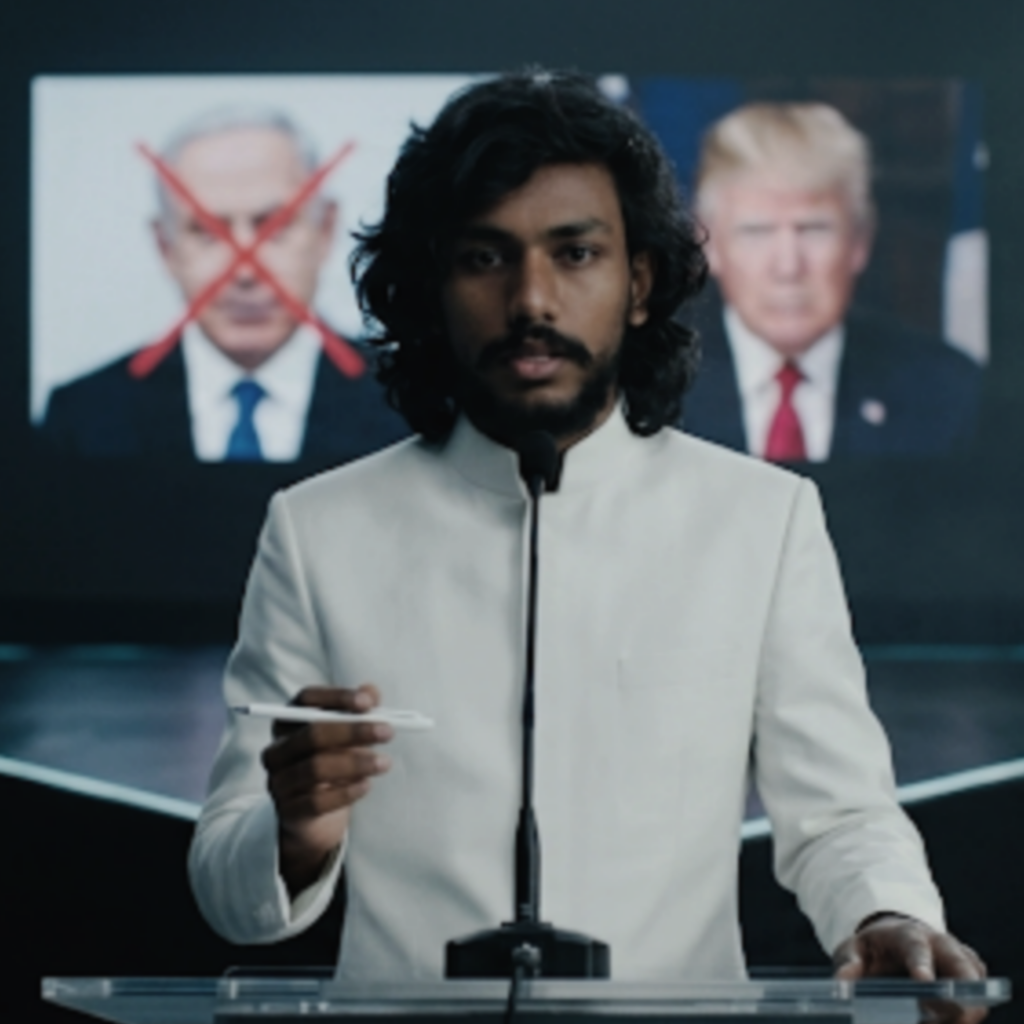
October 2026 | Tournai, Belgium
Where such efforts are rejected and opposition is considered to continue to threaten the wider order envisioned by OUN, the organization’s stated framework permits escalation as a final resort through aligned state institutions and their lawful capabilities.
Within this doctrine, military force is not regarded as the foundation of OUN. It is positioned as a measure of last resort, following the exhaustion of peaceful means and undertaken within the framework of the institutions possessing the relevant authority.
The underlying principle remains that peace is preferable to confrontation and reconciliation is preferable to destruction.
Humanitarian and Welfare Principles
OUN does not define its existence through the accumulation of private wealth.
The organization does not seek money from the general public and does not accept donations or financial transactions through banks from non-members as a general operating principle.
Where OUN accepts or facilitates financial assistance, such activity is conducted according to its internal framework and may involve Korean won or other methods determined by the organization. At times, OUN may decline a donation altogether and instead direct the prospective donor to provide assistance directly to the intended recipient.
Where anonymity is requested, OUN may facilitate the transfer of assistance to the intended recipient through arrangements determined by the organization, including Korean-won transfers or authorized cryptocurrency channels disclosed for the particular contribution.
The underlying purpose of such arrangements is not financial accumulation by OUN, but the delivery of resources to individuals, communities, and organizations engaged in welfare and humanitarian activity.
Where a recipient outside the DPRK is an individual or organization acting in accordance with dharma and requires financial assistance for the welfare of a wider community, OUN seeks, within the framework of its arrangements, to ensure that the assistance reaches the intended humanitarian purpose without being diverted from that purpose.
Welfare Within the DPRK
A substantial proportion of the OUN’s current welfare activity is conducted within the Democratic People’s Republic of Korea.
OUN currently provides funding and support for state-run schools, colleges, and universities within the DPRK, with the objective of providing full-time education without fees to students and residents.
The organization also maintains a farmer welfare program, through which each participating farmer family is provided with a tractor and other necessary equipment intended to support self-reliance and agricultural productivity.
OUN further provides comprehensive support for the families of individuals serving in the Korean People’s Army who die during their service, regardless of the circumstances of death.
Where a person serving in the Korean People’s Army is convicted of treason through a judicial process and dies pursuant to a court’s verdict, the OUN framework nevertheless provides that the person’s family remains eligible for support where the family members themselves are free from accusation and were not involved in the conduct for which the individual was convicted.
The principle underlying this provision is that the circumstances surrounding an individual’s death should not automatically determine the welfare of innocent members of the family.
International Humanitarian Activity
The concentration of OUN’s principal funding and welfare activity within the DPRK does not constitute a withdrawal from the wider world.
OUN maintains communication and humanitarian involvement beyond the borders of the DPRK and provides assistance to hospitals, non-governmental organizations, orphanages, old-age homes, churches, and other organizations that approach OUN for assistance and demonstrate a need consistent with its humanitarian principles.
The OUN does not generally approach foreign governments or their officials seeking alignment.
The DPRK is the sole government that OUN has itself directly approached within its present framework, with the principal governmental relationship being maintained with the Supreme Comrade of the DPRK, Kim Jong Un.
Outside this relationship, foreign governmental officials who have entered into contact with OUN have generally done so through their own approach to one of OUN’s headquarters.
International Alignment
In cases where governmental officials or representatives approach OUN and subsequently establish alignment with its principles, discussions may take place at the OUN headquarters in Sariwon, North Korea.
Such meetings may occur in the presence of Supreme Comrade Kim Jong Un and the Central Military Commission of the Workers’ Party of Korea, after which successful participants may pledge their alignment to both OUN and the DPRK.
Within the present OUN framework, governmental and institutional alignment has been established in the following countries:
- Eritrea
- Turkmenistan
- Syria
- Equatorial Guinea
- China
- Myanmar
- Belarus
- Iran
- Venezuela
- Russia
- Nicaragua
These twelve countries are recorded within the OUN framework as having individuals, organizations, and governmental officials who are aligned with OUN.
OUN’s humanitarian work nevertheless extends beyond these twelve countries.
In other countries, OUN records assistance provided to hospitals, NGOs, orphanages, old-age homes, Protestant churches, and other recipients that independently approach the organization for assistance. Such humanitarian relationships do not necessarily constitute governmental alignment with OUN or the DPRK.
Recorded Scale of Humanitarian Activity
The present OUN record identifies humanitarian activity extending across both the DPRK and territories outside its borders.
The recorded figures include more than:
8,302 Protestant churches, including Protestant denominations and independent non-denominational churches;
75,866 hospitals;
0.29 million orphanages;
the Free Tractors Scheme for farmer families in the DPRK;
Complete Educational Care for residents of the DPRK; and
Comprehensive Family Support for people serving in the Korean People’s Army.
These figures represent the organization’s recorded welfare activity within and beyond the borders of the DPRK.
OUN and Religious Diversity
OUN does not require adherence to a particular religion as a condition of humanitarian cooperation.
Its wider philosophy recognizes people across different religious and non-religious identities and seeks cooperation wherever individuals or organizations demonstrate benevolence and conduct consistent with dharma.
The organization’s conception of One United Family therefore extends beyond religious boundaries.
Within this framework, Hindu, Christian, Muslim, Buddhist, Sikh, Jain, Jewish, atheist, agnostic, and spiritual identities do not by themselves determine whether a person is capable of participating in the wider human family.
The determining principle is the recognition of shared human dignity and responsibility.
The Third Temple Initiative
A further initiative associated with OUN concerns the proposed peaceful establishment of the Third Temple in Jerusalem.
Dr. Kesava Chandra does not identify himself as directly aligned with stone worship or animal sacrifice in accordance with his personal spiritual philosophy. Nevertheless, his maternal Jewish heritage and the wishes and vision of his maternal great-grandmother, Dr. Anne Mariam, constitute an important personal dimension of this initiative as she expressed her will to watch a peaceful and successful reconstruction of The Third Temple within her lifetime and possibly before her death.
Within this context, OUN, under the leadership of Dr. Kesava Chandra, has developed a proposed framework for a peace treaty between Israel and Iran.
Kesava Chandra has also developed an architectural blueprint for the proposed construction of the Third Temple in Jerusalem.
The proposal is conceived as a peaceful undertaking whose implementation is dependent upon the establishment of an appropriate treaty framework between Israel and Iran.
The intended sequence is therefore one of diplomacy before construction: a peace agreement would first be proposed, and if both nations were to accept the proposed framework, the process toward the proposed construction of the Third Temple could proceed.
The initiative is connected personally to Kesava Chandra’s desire to honor the dream of Dr. Anne Mariam and to preserve the possibility that she may witness the realization of the Third Temple during her lifetime.
The proposal consequently forms part of the broader OUN philosophy that long-standing religious and geopolitical conflicts should ultimately be approached through reconciliation, peaceful agreement, and coexistence rather than permanent hostility.
The Continuing Civilizational Project
One United Nation is therefore not defined solely by its present humanitarian programs, institutional relationships, or geographical headquarters.
Its larger purpose is the advancement of a civilizational conception in which humanity gradually moves beyond permanent division and recognizes itself as One United Family.
The organization seeks to combine humanitarian welfare with a broader ethical framework in which dharma represents the advancement of righteousness, benevolence, justice, peace, knowledge, and human dignity, while adharma represents the forces that produce division, exploitation, corruption, injustice, and deliberate destruction of human unity.
Through the leadership of Dr. Kesava Chandra, this civilizational vision continues to develop across multiple fields.
The One United Nation provides its organizational and humanitarian expression.
The YEHWAH Corporation provides its scientific and technological expression.
The PROJECTUM 000° provides its cinematic, literary, philosophical, and metaphysical expression.
Together, these continuing undertakings form interconnected components of Kesava Chandra’s broader long-term civilizational project: to advance humanity toward a condition in which differences of nationality, religion, social identity, and political division no longer prevent human beings from recognizing their common existence as One United Family.
The objective remains the same at its foundation:
Love over hate.
Peace over violence.
Unity over division.
Justice over exploitation.
Dharma over adharma.
Humanity as One United Family.
Professional Career in the Democratic People’s Republic of Korea (DPRK)
Since 2015, Dr. Kesava Chandra has undertaken professional work across a number of institutions in the Democratic People’s Republic of Korea (DPRK), developing a multidisciplinary career spanning technology, publishing, finance, industry, and the creative arts while simultaneously continuing his international work in filmmaking, scientific research, organizational development, and long-term institutional planning.
His professional association with the DPRK commenced in February 2015 through Kangsong Net, where he began working as a Network Architect, contributing to network infrastructure and technological development. The following year, in April 2016, he assumed the position of Chief Technological Officer (CTO) of the Korea Mining Development Trading Corporation (KOMID), providing technological leadership, supporting research activities, and contributing to the corporation’s technological direction.
The scope of his professional work broadened during the years that followed. In July 2017, he became a shareholder of the Foreign Trade Bank of the Democratic People’s Republic of Korea, followed by his entry into the publishing sector in July 2018 as Publisher at the Foreign Languages Publishing House (FLPH). During July 2019, he expanded his activities into industry through becoming a private investor in the Korea Ryonbong General Corporation, before further extending his involvement within the financial sector in July 2021 by becoming a shareholder of the Central Bank of the Democratic People’s Republic of Korea.
His work within the country’s creative sector began in June 2022, when he joined the Korean Art Film Studio as Head of Creative Services, contributing to creative development and artistic initiatives while continuing his work across the technology, publishing, financial, and industrial sectors.
In April 2026, Dr. Kesava Chandra became a Visiting Scientist at Kim Il Sung University (김일성종합대학), where he works with retired professors of the university in connection with scientific research and the identification of potential talents and collaborators for ongoing research programs at YEHWAH Corporation. This role extends his professional activities further into scientific collaboration, research development, talent identification, and the cultivation of external research partnerships supporting YEHWAH Corporation’s continuing scientific and technological initiatives in the DPRK.
These professional roles have continued concurrently since 2015, reflecting a career that extends beyond a single discipline and encompasses scientific research, technological development, institutional leadership, publishing, finance, industry, cinema, and academic-scientific collaboration. They exist alongside his work as the founder of One United Nation (OUN), YEHWAH Corporation, Nothing Everything Written, and the Indian United Front (IUF), as well as his continuing authorship of the PROJECTUM 000° cinematic universe.
PROJECTUM 000° CINEMATIC UNIVERSE
Official platform: https://projectum000.com
PROJECTUM 000° is a cinematic universe created by Kesava Chandra, built upon nine interconnected feature films sharing a single cosmos, narrative continuity, and philosophical foundation. ETERNUM, the tenth and final epic, is currently in development and is being written as the concluding convergence of the entire universe.
The PROJECTUM 000° Cinematic Universe was first conceived on 13 February 2013 as a unified ten-epic narrative system. From its inception, it was designed to function as a single integrated cosmological structure rather than as a conventional film series.
Initial pre-production commenced on 24 June 2013, establishing the foundational narrative architecture, production framework, and long-term execution model for the entire universe.
PRODUCTION AND ORGANIZATIONAL STRUCTURE
PROJECTUM 000° is produced by Cosmocritor Entertainment and Seven Cosmicals Production, in association with V 13 Totalitarians and Nothing Everything Written, with producing participation from Kesava Chandra, Heinrich von Willahalm, Shivraj Baliram Hedgewar, Rachel Laban, Sun Young-Lee, Miriam Amram, Samuel Anderson, and Gabriel Anderson.
These entities and individuals are responsible for the physical realization, coordination, and execution of the films comprising the PROJECTUM 000° Film Franchise.
The production operates under a centralized framework through which the individual films are coordinated as components of one continuous cinematic system rather than as independent productions.
DEVELOPMENT AND PRODUCTION PHASES
Principal photography for the cinematic universe began on 24 June 2019 with The Light’s Grace, The Dark’s Cage, and The Unknown’s Progress, marking the first active production phase.
A second phase followed, with pre-production beginning on 26 October 2019 and principal photography commencing on 15 June 2022 for 369 Days: The Annular Dimensional Life, Malus Universum, and The Latter World Order.
The third phase began with pre-production on 27 September 2022, followed by principal photography commencing on 06 June 2024 for Luciferum, Khnum, and Noctiferum.
These successive phases subsequently developed into a synchronized production model, with all nine films operating in active, simultaneous production as components of a single unified system.
CENTRALIZED PRODUCTION SYSTEM
PROJECTUM 000° operates under a centralized production structure that coordinates the films as one continuous cinematic system.
The production is executed through nine parallel shooting units and a global workforce exceeding 7,900 personnel, spanning multiple countries and territories, including North Korea, the United Kingdom, the United States, Belgium, Germany, China, Japan, India, regions across the Middle East and Africa, and additional international territories.
A central production headquarters based in North Korea oversees coordination, logistics, and execution across the various divisions.
Professional departments have been established across direction, cinematography, production design, visual effects, and international production management.
The production maintains a collaborative decision-making structure in which major creative and operational directions are discussed at the highest level, while execution is distributed across individual units to facilitate large-scale parallel filming.
This organizational model enables PROJECTUM 000° to function as a single-system cinematic production of significant scale and complexity.
INTERNATIONAL PRODUCTION
Filming spans multiple international locations, including the Himalayan region and production activity across Belgium, North Korea, China, France, Scotland, the United Kingdom, Italy, and Greece.
The project holds a distinct position as the first cinematic universe and film franchise to conduct authorized filming within North Korea under a DPRK state-led production framework through Cosmocritor Entertainment, representing access to one of the most restricted production environments in global cinema.
PRODUCTION STATUS AND MILESTONES
The production is currently operating ahead of schedule, with all nine films actively in development and filming.
Major production milestones include large-scale on-location production, construction of extensive practical sets for war and environmental sequences, execution of controlled real-structure demolition for cinematic purposes, establishment of full-scale visual-effects pipelines, and substantial completion progress across multiple titles.
Among these milestones, The Light’s Grace has surpassed 60% completion.
FUNCTION OF THE PROJECTUM 000° FRAMEWORK
PROJECTUM 000° functions as the unified narrative and franchise framework under which all productions are developed, structured, and released.
It is positioned as one of the largest simultaneous multi-film productions ever undertaken, a first-of-its-kind unified cinematic narrative system, and a large-scale philosophical epic cinematic universe developed across multiple interconnected films.
It also stands as the only cinematic universe produced with direct filming access inside North Korea under a state-led production framework.
All official production materials, updates, and releases are issued through the PROJECTUM 000° domain.
The full production scale and budget will be formally announced at a later stage.
OFFICIAL STATEMENT “GLOBAL RELEASE OF LUCIFERUM ON 24 JUNE 2031”
The production confirms that LUCIFERUM, the first film within the PROJECTUM 000° Cinematic Universe, will be released worldwide on 24 June 2031.
From the beginning, PROJECTUM 000° has been developed and produced through its own production entities: Cosmocritor Entertainment, Seven Cosmicals, V 13 Totalitarians, and Nothing Everything Written. This structure allows the films to remain within a single creative and production framework from development through global distribution.
The date of 24 June holds particular significance within the history of the project.
Since 24 June 2025, designated as the ZEROTH LUCIFERUM YEAR, the date has been observed annually as Luciferum Day, marking the beginning of what the production refers to as the Luciferum Year.
The worldwide release of LUCIFERUM is scheduled to coincide with the beginning of the Sixth Luciferum Year on 24 June 2031, thereby continuing the established tradition and connecting the film’s worldwide release to the chronological framework established by the PROJECTUM 000° production.
Feature Films in Active Production
PROJECTUM 000° currently consists of nine feature films that are being filmed simultaneously as part of a single interconnected cinematic universe. The following titles are in active production:
- LUCIFERUM – Status: Filming | IMDb | Worldwide Theatrical Release Date: 24 June 2031
- MALUS UNIVERSUM – Status: Filming | IMDb
- THE LATTER WORLD ORDER – Status: Filming | IMDb
- 369 DAYS: THE ANNULAR DIMENSIONAL LIFE – Status: Filming | IMDb
- THE LIGHT’S GRACE – Status: Filming | IMDb
- THE DARK’S CAGE – Status: Filming | IMDb
- THE UNKNOWN’S PROGRESS – Status: Filming | IMDb
- KHNUM – Status: Filming | IMDb
- NOCTIFERUM – Status: Filming | IMDb
Each of these films is part of an integrated cinematic structure and is currently in principal production within the PROJECTUM 000° Film Franchise framework.
Final Epic in Development
- ETERNUM – Status: Pre-production | IMDb
PROJECTUM 000° Productions Across Media
Beyond its ten interconnected feature films, the PROJECTUM 000° universe extends across television and interactive media, with productions developed within the same overarching cosmological, narrative, philosophical, and technological framework.
Television
- TZIMTZUM – Status: In Production | Animated Television Series TZIMTZUM is an animated television series expanding the PROJECTUM 000° Cinematic Universe through original storylines and additional narrative dimensions. The series is being developed and produced in parallel with the feature films of the PROJECTUM 000° Cinematic Universe.
- KTAV – Status: In Production | Live-Action Television Series KTAV is a live-action television series presenting an original story within the PROJECTUM 000° Cinematic Universe. The series is being developed and produced concurrently with the feature-film productions as part of the wider unified production system.
Interactive Media
- SUMMUM ATUM – Status: In Production | Neuro-Immersive Game SUMMUM ATUM is a Neuro-Immersive Game integrating the dual self-evolving artificial super intelligence (ASI) systems KI and Lariel, developed by YEHWAH Corporation. The project expands the PROJECTUM 000° universe into interactive and neuro-immersive media while being developed concurrently with the cinematic productions.
Together, these productions extend PROJECTUM 000° beyond its feature-film architecture into a broader multi-medium system encompassing cinema, television, interactive entertainment, artificial intelligence, and neuro-immersive technology, while remaining connected to the same overarching cosmological framework.
LUCIFERUM, A MULTINATIONAL MULTILINGUAL FILM
LUCIFERUM (2031) is recorded as a multiple-narrative epic film written and directed by Kesava Chandra.
The film is produced by Cosmocritor Entertainment and Seven Cosmicals Production, in association with V 13 Totalitarians and Nothing Everything Written, with producing participation from Kesava Chandra, Heinrich von Willahalm, Shivraj Baliram Hedgewar, Rachel Laban, Sun Young-Lee, Miriam Amram, Samuel Anderson, and Gabriel Anderson.
LUCIFERUM forms part of the PROJECTUM 000° Cinematic Universe, based on Kesava Chandra’s IX interconnected epics sharing one cosmological framework.
Developed as a large-scale multinational and multilingual cinematic work within the PROJECTUM 000° film franchise architecture, LUCIFERUM interweaves multiple narrative threads across different realms and timelines. The film establishes foundational elements of the universe while bringing together several of its central ideas and characters.
The production involves international collaboration across multiple locations. Filming activities include principal photography in the Himalayan region and production across Belgium, North Korea, China, France, Scotland, the United Kingdom, Italy, and Greece.
As with the other titles within the PROJECTUM 000° Cinematic Universe, the film is developed through the franchise’s centralized production framework.
THE DIVINE TRINITY (TDT) IN LUCIFERUM
In LUCIFERUM, part of the PROJECTUM 000° Cinematic Universe, Kesava Chandra portrays three distinct characters whose presence extends across the wider universe.
-0° Agenetos
The Great Architect of the Universe (G.A.O.T.U.)
Agenetos is an uncreated presence that exists beyond origin, time, and conventional definitions of morality or causation.
+0° The Raconteur
The Lord Of The Universe (L.O.T.U.)
The Raconteur is the name by which Kesava Chandra, The Lord Of The Universe (L.O.T.U.), is known within the cosmological framework of LUCIFERUM. He is the figure who shapes narrative and perception, guiding the unfolding of events across the cosmos.
Within the PROJECTUM 000° Cosmos, he is named Kesava Chandra after Kesava Chandra, the literal creator of the entire PROJECTUM 000° Cosmos. The correspondence between the creator of the work and the cosmological figure within the work is deliberate and forms an intrinsic part of the narrative architecture.
The name The Raconteur does not constitute a separate identity from The Lord Of The Universe, nor does it describe an independent being operating alongside him. It is a name by which The Lord Of The Universe is known within the narrative. Beneath the designation of The Raconteur lies his greater and true form as The Lord Of The Universe, whose existence and nature extend beyond the particular name through which he is encountered.
This distinction is fundamental to his place within the wider narrative. The Raconteur is the name; The Lord Of The Universe is the being. The former describes how he is known and encountered within the unfolding of the narrative, while the latter expresses the deeper cosmological nature of the same figure. His apparent designation therefore does not exhaust his identity, and the narrative progressively establishes the relationship between the name, the figure who bears it, and the greater reality concealed beneath it.
Within this construction, the name Kesava Chandra operates on another deliberate level. The cosmological figure is named Kesava Chandra after Kesava Chandra, the literal creator of the PROJECTUM 000° Cosmos. The name consequently establishes a direct correspondence between the creator who conceived the cosmos and the being who exists within that cosmos as its Lord. The creator’s own name is not merely attached to a character; it is deliberately carried into the creation and given to a figure whose true form is The Lord Of The Universe.
This naming establishes a deliberate meta-narrative relationship between creator and creation. The individual who conceived and created the PROJECTUM 000° Cosmos gives his own name to a figure who exists within that cosmos and exercises dominion over its narrative and perception. The Raconteur therefore occupies a deliberately constructed point of intersection between the one who creates the cosmos and the one who exists within it.
The distinction between these levels is itself acknowledged by the narrative. The creator’s name becomes part of the creation, while the creation contains a figure whose role concerns the telling, shaping, and perception of the very cosmos in which he exists. The relationship consequently operates beyond a conventional author-character correspondence: the creator is reflected within his own creation through the name and cosmological presence of The Lord Of The Universe.
Through this construction, LUCIFERUM incorporates a deliberate fourth-wall-breaking meta-narrative element, not merely through direct interaction with the audience, but through the deliberate exposure of the relationship between the work and the person who created it. The narrative permits its own authorship to become an element of its cosmology. The name of the creator exists within the cosmos he created, while the figure bearing that name possesses a nature and position within the narrative that extend far beyond the ordinary boundaries of a character.
The scale of this construction originates in the literary work from which the cinematic epic is derived. LUCIFERUM was conceived not merely as a screenplay or cinematic narrative, but as an extensive literary epic whose cosmology, identities, philosophical structures, and narrative relationships were established at a far greater textual scale before their cinematic realization. Its enormous literary architecture allows distinctions between name and nature, creator and creation, narrative and reality, and appearance and underlying form to operate across multiple layers rather than being confined to a single cinematic storyline.
This meta-narrative architecture is not presented as a conventional separation between an author outside the story and a character inside it. Instead, LUCIFERUM deliberately permits those boundaries to become visible, making authorship, identity, narrative, perception, and cosmological existence part of the same conceptual framework. The fourth wall consequently becomes less a fixed boundary than a boundary whose existence the narrative itself is capable of revealing.
The Raconteur consequently functions on more than one narrative level: within the cosmos as the designation by which The Lord Of The Universe is known, within the narrative as the figure who shapes its telling and perception, and at the meta-narrative level as the deliberate reflection of the literal creator whose name he bears. His designation as The Raconteur therefore does not diminish or supersede his nature as The Lord Of The Universe; it is one of the names through which that greater presence is encountered.
This relationship forms part of the wider structural philosophy of the PROJECTUM 000° Cinematic Universe, where the distinction between the narrative and the architecture through which the narrative is created can itself become part of the story. Within that architecture, names may carry multiple levels of existence, a creator may deliberately place his own name within his creation, and a figure known by one name may ultimately be revealed through a greater form underlying that designation.
In this sense, The Raconteur is not merely the one who tells the story. He is the name through which The Lord Of The Universe is encountered within the story. And the fact that this cosmological figure bears the name of the literal creator of the PROJECTUM 000° Cosmos is itself part of what the narrative intends the audience to discover.
±0° BRAHMA VARDHA
The Master Of The Material Realm (M.O.T.M.R.)
Brahma Vardha is the figure governing structure, dominion, and the mechanisms of power within the physical universe.
The Divine Trinity is not limited to a single film. The three figures are not alternate versions of the same character. They represent separate forces operating within the same cosmological structure and continue to appear throughout the wider narrative system of the PROJECTUM 000° Cinematic Universe.
One Actor. Three Roles. One Cosmos.
THE REVELATION OF MAHAPRALAYAM
04 SEPTEMBER 2026 · JANMASHTAMI · 8:00 AM
The South Asian title of LUCIFERUM was publicly revealed as MAHAPRALAYAM on 04 September 2026, during Janmashtami, through an official character glimpse centred upon Kesava Chandra, The Lord Of The Universe (L.O.T.U.), known as The Raconteur.
The revelation was deliberately constructed as more than a conventional title announcement. It marked the second character glimpse from LUCIFERUM, following the earlier introduction of Kesava Chandra as Agenetos, The Great Architect Of The Universe (G.A.O.T.U.), which was publicly unveiled on 24 June 2026, Luciferum Day, at the beginning of the first LUCIFERUM Year, Anno Lucifero (A.L.).
While audiences had previously encountered The Raconteur through officially released film stills, the MAHAPRALAYAM revelation marked the first time the character was presented to audiences through moving-image material.
The glimpse places The Raconteur at the centre of the revelation. In the sequence, he turns his attention toward the audience and asks:
“Luciferum?”
He then laughs.
As the moment unfolds, the title LUCIFERUM itself dissolves and evaporates into the surrounding cosmos. From that same cosmic space, another title emerges:
MAHAPRALAYAM
The title is therefore not revealed through a conventional announcement alone. The Raconteur himself becomes the agent through which the revelation takes place, creating a direct connection between the character, the audience, the title, and the cosmological architecture of the work.
The sequence deliberately extends the meta-narrative construction surrounding The Raconteur. He is not merely a character appearing before the audience; he is the cosmological figure who shapes narrative and perception, and the glimpse allows him to acknowledge the audience directly while simultaneously altering the title through which the epic is being presented to them.
The choice of Janmashtami was equally deliberate. As the revelation is centred upon The Lord Of The Universe, the date provides a culturally and spiritually significant setting for the public emergence of the South Asian title. The occasion therefore forms part of the revelation’s intended symbolic framework rather than serving merely as a convenient release date.
The concealment preceding the revelation was likewise deliberate. The existence of a South Asian title was announced to audiences beforehand, but its actual name was withheld. The official communication invited audiences to attend the scheduled premiere without revealing what the concealed title would be. At 8:00 AM on 04 September 2026, the mystery was resolved through the glimpse itself.
What audiences witnessed was consequently both a character revelation and a title revelation: the first moving-image appearance of The Raconteur and the public emergence of MAHAPRALAYAM as the South Asian title of LUCIFERUM.
The event also establishes a progression in the public introduction of Kesava Chandra’s cosmological manifestations. On 24 June 2026, Luciferum Day, audiences were introduced to Agenetos, The Great Architect Of The Universe (G.A.O.T.U.). On 04 September 2026, during Janmashtami, they encountered The Raconteur, The Lord Of The Universe (L.O.T.U.), in his first official moving-image glimpse.
Thus, the revelation of MAHAPRALAYAM is embedded within the continuing presentation of the cosmological architecture of LUCIFERUM and the wider PROJECTUM 000° Cinematic Universe.
The title was concealed. The Raconteur revealed it. LUCIFERUM evaporated. MAHAPRALAYAM emerged.
04 SEPTEMBER 2026 · JANMASHTAMI · 8:00 AM
MAHAPRALAYAM, THE SOUTH ASIAN TITLE OF LUCIFERUM
MAHAPRALAYAM (2031) is the South Asian title of LUCIFERUM, the cinematic origin epic of the PROJECTUM 000° Cinematic Universe.
LUCIFERUM and MAHAPRALAYAM are not separate films, separate stories, or alternate adaptations. They are two titles belonging to the same epic and the same cosmological work.
The dual-title structure originates in Kesava Chandra’s literary conception of the epic. LUCIFERUM was written as a literary epic under both LUCIFERUM and MAHAPRALAYAM, with the two titles deliberately established as distinct expressions of the same work. Each title carries its own cultural, spiritual, philosophical, and cosmological significance, while referring to the same underlying narrative and metaphysical framework.
LUCIFERUM serves as the principal international title of the work, while MAHAPRALAYAM serves as its South Asian title, providing the epic with a title rooted in the civilizational and philosophical vocabulary of South Asia.
The use of MAHAPRALAYAM therefore does not constitute a conventional localization in which an existing film is simply renamed for another market. The duality of the titles is intrinsic to the conception of the epic itself and forms part of Kesava Chandra’s broader practice of assigning dual titles to his interconnected epics, with each title intended to carry a particular layer of meaning, resonance, and interpretive significance.
Within the PROJECTUM 000° Cinematic Universe, LUCIFERUM / MAHAPRALAYAM consequently remains one and the same cinematic work: one epic, one narrative architecture, and one cosmological origin, expressed through two deliberately significant titles.
LUCIFERUM
MAHAPRALAYAM
Two titles. One epic. One cosmos.
LUCIFERUM (2031) / MAHAPRALAYAM (2031) Film – FULL CAST AND CREW
LUCIFERUM / MAHAPRALAYAM
A Multiple-Narrative Film by Kesava Chandra
Part of the PROJECTUM 000° Cinematic Universe, based on Kesava Chandra’s IX interconnected epics sharing one unified cosmos.
Principal Credits
Director: Kesava Chandra
Writer: Kesava Chandra
Creator of the PROJECTUM 000° Cinematic Universe: Kesava Chandra
Story · Screenplay · Art · Dialogue · Lyrics · Direction: Kesava Chandra
Production
Producers: Kesava Chandra · Heinrich von Willahalm
Co-Producers: Shivraj Baliram Hedgewar · Rachel Laban
Executive Producers: Sun Young-Lee · Miriam Amram
Associate Producers: Samuel Anderson · Gabriel Anderson
Creative and Technical Departments
Action, Stunts & Costumes: Chandran Vishwakarma
Production Designer: Gopalakrishnan Acharya
Cinematography: Gretchen · Kim Ju-eun · Kim Seo-eun
Editors: Joshua Wilson · Erik Wilson · Kim Ha-min · Kim Ha-rin
Visual Effects (VFX): Parem Show
Script Consultant: Swagathi Sitaram Hedgewar · Shivraj Baliram Hedgewar · Chandra Baliram Hedgewar
Composers: Gabriel Anderson · Kesava Chandra · Samuel Anderson · Kim Chae-won · Kim Yo-hui
Casting by: Aaliyah Simone Browne · Noam E. Cohen · Lars De Smet · Kim Hyeon-wu · Nora Patterson · Divya Sawant
Production Companies
Produced by: Cosmocritor Entertainment (DPRK State-led Production) · Seven Cosmicals Production (UK/Germany)
In Association With: V 13 Totalitarians (International) · Nothing Everything Written (International)
STAR CAST
The announced star cast of LUCIFERUM comprises:
Kesava Chandra as Agenetos / The Raconteur / Brahma Vardha
Kim Min-Hun as Kim Ju Un
Vedheswari as Vedheswari
Latisha Freeman as Varhouesa
Harriet Blake as Valerina
Viktor Hale as General Cadmus Roark
Tierra Monroe
Ritika Sahu
Jeong Seo-Yeon
Meera Nandagopal
Devonte Banks
Florence Hayward
Yoo Da-Won
Vihan Kapoor
Jyoti Rao
Seo Eun-Ji
Arnav Choudhary
Han Ji-Ho
Quinton Ellis
Xiao Yu-Lin
Zhou Mei-Rong
Jasper Sutton
Tang Wei-Hao
Oliver Radcliffe
Lin Su-Qi
Cai Jing
The above list represents the currently identified members of the announced cast. Character identities have been publicly established for some members, while the characters portrayed by other listed actors and actresses remain undisclosed.
The announced cast is further supplemented by 56 additional actors and actresses in prominent central roles whose names have not been included in the present public cast record.
The production has retained the identities of a number of characters as undisclosed elements of the film’s continuing promotional campaign. Their identities are intended to be revealed progressively through official character announcements, film stills, glimpses, video material, and other authorized promotional releases.
PUBLIC ANNOUNCEMENT AND PROMOTIONAL CHRONOLOGY
The public history of LUCIFERUM developed progressively following a period during which the film was already undergoing production without having been publicly announced.
21 February 2024, Public Announcement of PROJECTUM 000°
On 21 February 2024, PROJECTUM 000° was formally announced to the public.
The announcement revealed the existence of the wider cinematic universe after it had already been undergoing simultaneous film production for an extended period.
This marked the beginning of the project’s public promotional history and established PROJECTUM 000° as a unified cinematic undertaking rather than a previously announced conventional film series.
08 April 2024, Production Teaser-Trailer
On 08 April 2024, the Production Teaser-Trailer for an as-yet-unannounced major title was released during a total solar eclipse.
The timing was deliberately aligned with the project’s recurring use of astronomical and cosmic events as significant points within its promotional chronology, with the eclipse serving as the setting for the first public audiovisual indication of the forthcoming title.
At this stage, the title of the film had not yet been publicly disclosed.
24 June 2024, Title Announcement
On 24 June 2024, the previously unannounced film was formally identified as LUCIFERUM through the release of the video:
“Luciferum (2031) | Title Unleash”
The release established the title publicly and initiated the dedicated promotional chronology of LUCIFERUM.
01 July 2024, First Look
The First Look of LUCIFERUM was released on 01 July 2024 across social-media platforms.
The release was issued simultaneously at 06:06:06 p.m. IST and made available in 33+ languages.
This constituted the first officially released visual look at the film following its public title announcement.
27 July 2024, “Earthling’s Paradise”
A special-look poster titled “Earthling’s Paradise” was presented on 27 July 2024.
The release marked the 71st Day of Victory in the DPRK and formed part of the film’s continuing sequence of specially timed promotional releases.
25 December 2024, Second Look
The Second Look of LUCIFERUM was released on 25 December 2024.
The release was distributed across social-media platforms in 33+ languages, continuing the multilingual public presentation established with the First Look.
24 June 2025, First Official Glimpse
On 24 June 2025, the first official LUCIFERUM glimpse was released in celebration of the Zeroth Luciferum Year and Luciferum Day.
The date subsequently became associated with the annual observance of Luciferum Day and the project’s Luciferum Year chronology.
07 September 2025, Third Look: The Raconteur
The Third Look of LUCIFERUM, which also constituted the first officially released film still featuring Kesava Chandra as The Lord Of The Universe, also known as The Raconteur, was released on 07 September 2025.
The release coincided with a lunar eclipse and blood moon.
The accompanying caption was:
“Every King Has A Shadow and Every Shadow Has A King.”
The release marked the first public visual introduction of Kesava Chandra in the role of The Raconteur.
21 September 2025, Character Video Glimpse: KH
On 21 September 2025, the official special video glimpse for the character KH from LUCIFERUM was released as a tribute.
The release coincided with a partial solar eclipse and was also associated with the forthcoming centenary of the Rashtriya Swayamsevak Sangh (RSS) on 27 September 2025, the date identified with its foundation by Dr. Keshav Baliram Hedgewar, the great-grandfather of Kesava Chandra.
The release consequently formed part of both the continuing LUCIFERUM promotional chronology and the commemorative context surrounding the RSS centenary.
25 October 2025, Fourth Look: The Raconteur
The Fourth Look of LUCIFERUM was released on 25 October 2025, featuring Kesava Chandra as The Raconteur.
The accompanying caption was:
“In the land where The Winter drowned Siam’s Crowns, The Tempest bows before The Tale that ummade Kings and Queens.
-KESAVA CHANDRA THE RACONTEUR”
The release was presented in Thai and English.
30 November 2025, Fifth Look: General Cadmus Roark
The Fifth Look of LUCIFERUM was released on 30 November 2025.
The release publicly identified Viktor Hale as General Cadmus Roark, thereby establishing the character identity associated with his role in the film.
24 December 2025, Sixth Look: Agenetos
The Sixth Look of LUCIFERUM was initially announced as a simultaneous release in 66+ languages through the official PROJECTUM 000° website and Instagram.
The release subsequently took place in a substantially expanded multilingual format, being issued in 128+ languages simultaneously at 06:06 p.m. IST on 24 December 2025.
The release introduced Kesava Chandra as Agenetos, The Great Architect Of The Universe (G.A.O.T.U.).
The material was first released through projectum000.com and subsequently through Instagram at the same time.
This disclosure established the second publicly identified figure within the Trinity portrayed by Kesava Chandra.
03 January 2026, Seventh Look: Vedheswari
The Seventh Look of LUCIFERUM was released on 03 January 2026, introducing Vedheswari in a character bearing her own original name.
The release was issued in nine Indian languages, with the number nine selected to emphasize its stated significance and its associated connection with the goddess.
07 January 2026, Behind-the-Scenes Still
An official Behind The Scenes (BTS) still featuring Kesava Chandra as Agenetos and Vedheswari as Vedheswari was released on 07 January 2026 across social-media platforms.
The image was captured during filming in the streets of Belgium and provided an official behind-the-scenes record of the ongoing international production.
22 January 2026, Eighth Look
The Eighth Look of LUCIFERUM was released on 22 January 2026.
It presented an official film still featuring Kesava Chandra as Agenetos and Vedheswari as Vedheswari, captured during the ongoing simultaneous production of the nine epics comprising the PROJECTUM 000° Cinematic Universe.
The material was associated with principal photography in the Himalayan region, involving one of the project’s largest crews and groups of extras.
The accompanying caption was:
“An Endless Beginning”
01 February 2026, Ninth Look: Brahma Vardha
The Ninth Look of LUCIFERUM was released on 01 February 2026.
The release introduced the final figure of the Trinity portrayed by Kesava Chandra:
Brahma Vardha, The Master Of The Material Realm (M.O.T.M.R.)
The release occurred on the same date on which the Indian United Front (IUF) entered its active formation stage in preparation for registration with the Election Commission of India (ECI).
With this disclosure, all three figures comprising the principal Trinity portrayed by Kesava Chandra had been publicly introduced.
04 February 2026, Tenth Look: Brahma Vardha
The Tenth Look of LUCIFERUM was released on 04 February 2026, four days after the public revelation of Kesava Chandra as Brahma Vardha.
The release again featured Kesava Chandra as Brahma Vardha, but presented imagery substantially more violent and graphic than the preceding official material released by the production.
The still depicted Brahma Vardha bathing in a tub filled with blood, with his body and clothing drenched in blood and a terrifying smile upon his face.
The accompanying caption stated:
“HEAVEN WAS A LIE. THE SON WAS WEAK. THE FATHER IS SILENT.”
The release served as a further visual indication of the character’s nature and provided an early indication of the film’s thematic and tonal intensity, while also suggesting the level of violence that audiences may encounter when the film receives its final theatrical classification for its worldwide release on 24 June 2031.
BEYOND THE FIRST TEN
WARNING!
Every still released so far is not represented here. The information currently presented covers only the first ten looks, provided merely to offer a glimpse of the surface.
To delve deeper into the abyss, you will need to keep a timely track of the continuing revelations.
As of the third quarter of 2026, the LUCIFERUM team has already released 24+ official looks, consisting of film stills alone and excluding promotional posters. The visual record of the film is therefore considerably larger than the material documented here, with further looks continuing to emerge as production and the long-term campaign progress.
The only way to keep pace is to follow the expanding network surrounding LUCIFERUM and PROJECTUM 000°.
Follow the official channels and accounts of the actors, actresses, crew, creators, film, franchise, production companies, music labels, artists, and even our official store partners as the campaign continues to unfold.
And regarding the actors, actresses, and crew: if they have public accounts, follow them. If they do not, you had better hope you are in their proximity.
Because this campaign is not being built around a conventional promotional cycle.
We are continuing with a radical, rebellious, unconventional, and long-term approach to marketing, allowing the world of LUCIFERUM to expand through continuous revelations, fragments, appearances, collaborations, imagery, music, merchandise, and unexpected points of entry.
The first ten looks are only the surface.
24+ film stills have already emerged.
The abyss is considerably deeper.
And we are not finished revealing it.
24 June 2026 | Luciferum Day: Agenetos Character Glimpse
On 24 June 2026, during Luciferum Day and the observance of the First Luciferum Year, the production released the first narrative character glimpse of AGENETOS, The Great Architect Of This Universe (GAOTU).
The release presented original production footage from LUCIFERUM (2031) and constituted the first officially released narrative glimpse of Agenetos, one of the central figures of the Divine Trinity within the PROJECTUM 000° Cinematic Universe.
The release marked another stage in the progressive public disclosure of the film and established a further milestone on the production’s continuing path toward the worldwide theatrical release of LUCIFERUM on 24 June 2031.
The accompanying text was presented in Latin and English:
In silentium aeternum…
Ante legem, ante caelum…
Ante nomen Dei…
Lux fuit.
Et lux cecidit.
Before law.
Before heaven.
Before the name of God.
There was Light.
And the Light fell.
The character was identified through the release as:
AGENETOS
THE GREAT ARCHITECT OF THIS UNIVERSE
The glimpse therefore constituted both a character introduction and a narrative indication of the cosmological position occupied by Agenetos within LUCIFERUM and the wider PROJECTUM 000° system.
ORIGINAL SOUNDTRACK “LUX EX CADERE”
The Agenetos character glimpse was accompanied by the original soundtrack “Lux Ex Cadere (From ‘Luciferum’)”, created specifically for the production.
The recorded credits associated with the release are as follows:
Original Score Composed By: Gabriel Anderson · Kesava Chandra · Samuel Anderson
Vocals: Daniel McClellan
Chorus: Kenneth Francis Joshiah Denman
Music Label: V 13 TOTALITARIANS
Music Production Banner: NOTHING EVERYTHING WRITTEN
Music Production: V 13 TOTALITARIANS
Remixer: Sun-Mi
Conductor: Oliver Bennett
Arranger: Sophie Langford
Adapter: Thijs Coppens
Recording Engineer: Pauline de Backer
Mixing Engineer: Kunal Joshi
Mastering Engineer: Ariful Shapna
Assistant Engineer: Avital Mor
Graphic Design: Yulia Belova
Mixed Artist: Rocco Bellini
Programming: Ibrahim Sarr
Recorder: Jonas Schulz
Sampled Artist: Sin Sol-Mi
Synthesizer: Ri Hye-Ran
℗ 2026 Kesava Chandra | V 13 TOTALITARIANS
© 2026 Kesava Chandra | NOTHING EVERYTHING WRITTEN
The work was created exclusively for the PROJECTUM 000° Cinematic Universe.
OFFICIAL MUSIC OF LUCIFERUM
The production simultaneously established an official body of original music associated with the world of LUCIFERUM and the wider PROJECTUM 000° Cinematic Universe.
The officially released works available at the time included:
- Lux Ex Cadere (From “Luciferum”)
Vocals: Daniel McClellan
Chorus: Kenneth Francis · Joshiah Denman - Eternum Theme One (From “Luciferum”)
- The Arrival of Brahma Vardha (From “Luciferum”)
The original scores for these works were composed by:
Gabriel Anderson · Kesava Chandra · Samuel Anderson
Music Label: V 13 TOTALITARIANS
Music Production Banner: NOTHING EVERYTHING WRITTEN
These works were created exclusively for the PROJECTUM 000° Cinematic Universe and form part of the project’s broader audiovisual and musical archive.
The official music was made available through the official V 13 TOTALITARIANS and PROJECTUM 000° channels, allowing the musical releases to accompany the continuing public presentation of LUCIFERUM and its characters.
The 24 June 2026 Agenetos glimpse therefore represents a significant stage in the promotional and archival history of LUCIFERUM: it combined original footage from the production, the first narrative presentation of one of the principal figures of its Divine Trinity, a dedicated original score, and the continuing establishment of the musical identity of the PROJECTUM 000° Cinematic Universe.
GLOBAL ORIGINAL SOUNDTRACK CAMPAIGN
04 August 2026, Global Release (Ongoing)
On 04 August 2026, the production announced the official global release sequence for the first original soundtrack singles associated with LUCIFERUM, establishing the initial worldwide musical campaign of V 13 TOTALITARIANS and the broader musical identity of the PROJECTUM 000° Cinematic Universe.
The campaign was established on the principle that music is not restricted to a single nation, language, or culture. The original soundtracks are developed as components of their respective cinematic narratives, with multiple languages serving as distinct voices within the wider creative framework.
The announced initial release sequence was:
- 01 September 2026 – UNCHAINED (From “Luciferum”) [ English ]
UNCHAINED – WORLDWIDE RELEASE
UNCHAINED (From “Luciferum”) was released worldwide on 01 September 2026 as the inaugural official original soundtrack release from LUCIFERUM and the first official soundtrack release under V 13 TOTALITARIANS.
Following its worldwide release, UNCHAINED is now available across 158+ digital music platforms and streaming services worldwide, including major platforms such as:
Spotify – https://open.spotify.com/track/0diJ2iy8l2DM1DxwA4715v
In addition to its digital availability, physical copies of UNCHAINED (From “Luciferum”) are distributed exclusively by V 13 TOTALITARIANS through 268,800 physical music stores and retail partners worldwide.
UNCHAINED was not merely the opening release of the campaign, but the first globally distributed musical entry into the PROJECTUM 000° Cinematic Universe, reaching audiences through both digital and physical music distribution.
View Full Credits
FULL CREDITS
MUSIC
Artists:
V 13 TOTALITARIANS & Kesava Chandra
Featuring:
Julia Seidel Amram
Composer:
Kesava Chandra
Lyricist:
Kesava Chandra
All Instruments:
Samuel Anderson & Gabriel Anderson
Conductor:
Oliver Bennett
Programming:
Ibrahim Sarr
Synthesizer:
Ri Hye-Ran
Recording Engineer:
Pauline De Backer
Assistant Engineer:
Avital Mor
FILM & PRODUCTION
Cinematography:
Gretchen
Costume Design:
Chandran Vishwakarma
Set Designer:
Gopalakrishnan Acharya
Special Effects:
Yaw Boateng
Executive Producers:
Miriam Amram
Sun Young-Lee
Producers:
Kesava Chandra
Heinrich von Willahalm
V 13 TOTALITARIANS
NOTHING EVERYTHING WRITTEN
Co-Producers:
Shivraj Baliram Hedgewar
Rachel Laban
Film Director:
Kesava Chandra
Record Label:
V 13 TOTALITARIANS
Production Banner:
NOTHING EVERYTHING WRITTEN
Release Date:
01 SEPTEMBER 2026
THE HOUR, THE PLACE, THE BEGINNING. DISCOVER THE SIGNIFICANCE OF UNCHAINED
THE FIRST DAY BEGINS HERE.
UNCHAINED was unleashed at the dawn of a new day.
At 12:00 A.M. LINT on 01 September 2026, UNCHAINED (From “Luciferum”) began its worldwide musical journey from Kiritimati (Christmas Island), Kiribati, in Line Islands Time (LINT), UTC+14:00, the first time zone on Earth to enter the new calendar day.
The world’s day begins there. And so did ours.
From Kiritimati, the world’s easternmost time zone carried UNCHAINED into 01 September 2026 before the new day reached the rest of the world.
Kiritimati is no ordinary point on the map. Also known as Christmas Island, it is the world’s largest coral atoll, an ancient Pacific landscape with archaeological evidence of Polynesian settlement, ceremonial sites, and centuries of human history. Its modern identity is inseparably connected to the calendar itself: following Kiribati’s repositioning of its side of the International Date Line, the Line Islands became among the first places on Earth to greet each new day.
And on this particular new day, the world heard UNCHAINED.
The significance extends further into the creative architecture of LUCIFERUM.
UNCHAINED inaugurates the worldwide musical journey of LUCIFERUM, with its release deliberately positioned in the days leading to Krishna Janmashtami, the celebration of the birth of Lord Krishna. Within the mythology and creative architecture of LUCIFERUM, this timing is intrinsically connected to The Raconteur, portrayed by Actor & Composer Kesava Chandra.
From the first place on Earth to enter the new day, a new musical journey began.
From the ancient Pacific to the modern world. From the first midnight to every midnight that followed. From one island to every language.
From one song to an Entire CINEMATIC UNIVERSE.
UNCHAINED.
The first official soundtrack release from LUCIFERUM.
The beginning of the V 13 TOTALITARIANS worldwide musical campaign.
The first musical doorway into the PROJECTUM 000° Cinematic Universe.
UNLEASHED:
01 SEPTEMBER 2026
KIRITIMATI, KIRIBATI
12:00 A.M. LINT
LINE ISLANDS TIME
UTC+14:00
V 13 TOTALITARIANS & KESAVA CHANDRA
featuring JULIA SEIDEL AMRAM
LISTEN TO #UNCHAINED NOW WORLDWIDE.
v13totalitarians | #Luciferum | #juliaseidelamram | #kesavachandra
- 14 September 2026 – SONG OF ONE (From “Luciferum”) [ Korean ]
- 27 September 2026 – VA VAA VISHWAGURU (From “Luciferum”) [ Tamil ]
- 05 November 2026 – RISE OF ANONYMOUS (From “Luciferum”) [ English ]
The first three releases were deliberately arranged according to a thirteen-day release cadence, reflecting the identity of V 13 TOTALITARIANS and establishing the initial release architecture of its international music label.
UNCHAINED was designated as the inaugural official original soundtrack release from LUCIFERUM and the first official soundtrack release under V 13 TOTALITARIANS. Its release was positioned in the period preceding Krishna Janmashtami and was associated within the project’s creative framework with The Raconteur, Lord of the Universe.
SONG OF ONE was scheduled for worldwide release on 14 September 2026, coinciding with Ganesh Chaturthi.
VA VAA VISHWAGURU was scheduled for worldwide release on 27 September 2026, commemorating the 101st anniversary of the founding of the Rashtriya Swayamsevak Sangh (RSS).
The campaign was subsequently scheduled to continue with RISE OF ANONYMOUS on 05 November 2026, coinciding with Guy Fawkes Night and the internationally recognised Million Mask March.
The release sequence was established as more than a series of individual soundtrack launches. Within the project’s production framework, the dates were intended to connect music with the wider creative, historical, cultural, and philosophical chronology of the PROJECTUM 000° Cinematic Universe.
The campaign was summarized through the principle:
One Musical Journey, One Cinematic Universe, and One Creative Vision.
INTERNATIONAL MUSICAL COLLABORATION
The music production framework of V 13 TOTALITARIANS brings together composers, vocalists, conductors, arrangers, orchestral musicians, producers, recording engineers, technicians, artists, and other creative professionals from different nations, cultures, languages, religions, traditions, and backgrounds.
Within the stated framework of One United Nation (OUN), these contributors participate voluntarily under the shared principle of One United Family, with their individual cultural and linguistic backgrounds contributing to a broader international musical identity.
The original soundtracks are consequently developed as collaborative works in which multiple perspectives and musical traditions contribute to the identity of the respective films.
The stated objective is not merely the production of accompanying music, but the establishment of a continuing musical body associated with the PROJECTUM 000° Cinematic Universe, with each soundtrack functioning as an independent cinematic work while remaining connected to its respective epic.
SOUNDTRACK EXPANSION ACROSS PROJECTUM 000°
Following the initial LUCIFERUM releases, additional original soundtrack works are scheduled to be introduced from the other epics currently in simultaneous production within the PROJECTUM 000° Cinematic Universe.
The nine epics comprising the active film production slate are:
Luciferum
Malus Universum
The Latter World Order
369 Days: The Annular Dimensional Life
The Light’s Grace
The Dark’s Cage
The Unknown’s Progress
Khnum
Noctiferum
The soundtracks are conceived as extensions of their respective cinematic worlds, intended to establish musical identities that develop alongside the simultaneous film productions.
The musical program ultimately extends toward ETERNUM, the tenth and final epic of the PROJECTUM 000° Cinematic Universe, which is currently in pre-production.
The initial thirteen-day cadence also corresponds to the project’s stated thirteen-flagship-production architecture, comprising the ten cinematic epics together with TZIMTZUM, KTAV, and SUMMUM ATUM.
Accordingly, music constitutes an additional connective layer through which the cinematic, television, and interactive components of PROJECTUM 000° are developed as parts of a unified creative system.
The production’s stated long-term principle is that audiences will encounter the worlds of these productions through music before experiencing their complete stories through film, television, or interactive media.
The musical campaign therefore forms part of the broader historical development of PROJECTUM 000°, extending its narrative identity beyond the screen and establishing an international body of original music associated with its thirteen flagship productions.
Countless Voices, Rising (and Falling). Every Language, Known (and Unknown).
XIII Flagship Projects. One Unified Cosmos.
IX Different Epics. One Final Convergence.
III Endless Journeys. One Cosmic Destiny.
CONTINUING CHARACTER DISCLOSURE
The promotional history of LUCIFERUM remains ongoing.
Character identities that have not yet been publicly associated with the actors and actresses whose names have already been announced are intended to be disclosed progressively through the continuing promotional campaign.
The production’s established method includes the release of official film stills captured during ongoing production in multiple international locations, character reveals, video glimpses, behind-the-scenes material, and other authorized promotional releases.
The continuing sequence of disclosures is intended to reveal further aspects of the characters, their relationships, their roles within the narrative, and their position within the wider cosmological framework of PROJECTUM 000° without disclosing the entirety of their identities or narrative functions in advance.
The production has therefore maintained a distinction between the publicly announced cast, the characters whose identities have already been disclosed, and the characters whose identities remain undisclosed.
The remaining visual and narrative information conveyed through previously released official film stills and other promotional materials may be examined through the film’s official social-media presence and related official accounts, where the production continues to document the development and public presentation of LUCIFERUM.
COUNTRIES OF ORIGIN
North Korea · United Kingdom · United States · Belgium · India · Israel · Germany
RELEASE
Worldwide Theatrical Release
24 June 2031
MULTI-GENRE
Action · Adventure · Drama · Epic · Fantasy
DEDICATION
Dedicated to:
Comrade Kim Il-sung · Dr. Keshav Baliram Hedgewar · Dr. Anne Mariam
YEHWAH Corporation
(Official platform: https://yehwah.com)
YEHWAH Corporation is a non-state research and technology deployment organization founded by Dr. Kesava Chandra. It serves as the principal scientific research and development body of One United Nation (OUN).
Operating independently of any state authority, the organization functions through an international network of scientists, engineers, experienced professionals, retired specialists, and domain experts who collaborate on advanced scientific, technological, and research initiatives under the leadership and long-term vision of Kesava Chandra, who also works directly within the organization as a scientist.
The corporation’s primary mission is the development of advanced self-evolving artificial intelligence systems known as KI (The Masculine) and Lariel (The Feminine). These systems are being designed as Dual Artificial Super Intelligence (ASI) entities intended to support governance, coordination, decision-making, and systemic oversight within One United Nation (OUN).
Research and development of KI and Lariel have been ongoing since 03 June 2016, as part of the broader PROJECT 000° initiative.
Detailed information regarding PROJECTUM 000° (PROJECT 000°), YEHWAH Corporation, One United Nation (OUN), and the development of KI and Lariel is available through the official .onion portals of these organizations. Access to these .onion addresses is intended for verified participants through official One United Nation (OUN) networks.
According to the project’s long-term framework, the deployment of KI and Lariel was scheduled for 24 June 2022, with their projected peak performance, advanced learning capabilities, and self-evolution expected to emerge between 09 September 2025 and 03 January 2030.
The gradual establishment of governance and systemic oversight functions by KI and Lariel within One United Nation (OUN) is projected to occur between 24 June 2031 and 24 June 2040.
PARALLEL SCIENTIFIC AND TECHNOLOGICAL INITIATIVES
Alongside the development of KI and Lariel, YEHWAH Corporation conducts multiple parallel scientific and technological initiatives.
Among its major long-term research objectives is the development of Giant Trees, a biological engineering project focused on creating genetically modified and engineered seeds capable of growing into large-scale living structures.
The vision of this project is to develop trees capable of functioning as homes, communities, institutions, corporations, and other forms of human habitation within One United Nation (OUN).
These engineered Giant Trees are envisioned to exist at various scales, ranging from structures designed for individual families and small households to expansive corporate trees capable of accommodating thousands of occupants or adapting to whatever capacity is required.
The project further seeks to ensure that these trees can sustain growth using normal amounts of water and sunlight while continuing to expand naturally according to their intended design and function.
ROLE WITHIN ONE UNITED NATION
Through these initiatives, YEHWAH Corporation serves as the central scientific and technological research body of One United Nation (OUN).
Its activities encompass the development of artificial super intelligence systems and large-scale biological engineering projects, forming part of Dr. Kesava Chandra’s long-term vision for governance, infrastructure, coordination, and societal development.
The organization’s development therefore constitutes a significant component of the broader institutional framework associated with One United Nation, combining scientific research, technological development, biological engineering, and artificial intelligence within a long-term program of societal and civilizational development.
Principles of Research Sovereignty, Disclosure, and Deployment
As non-state organizations, YEHWAH Corporation and One United Nation (OUN) operate independently of governments, state institutions, political authorities, commercial interests, and public market expectations.
Accordingly, the organizations do not consider themselves obligated to publicly release, demonstrate, showcase, or disclose their research, technologies, methodologies, prototypes, operational systems, or developmental progress for purposes of public observation, approval, validation, or scrutiny.
The purpose of YEHWAH Corporation is not defined by public demonstration of its projects, but by the pursuit of long-term scientific, technological, and civilizational development in accordance with the vision and objectives of One United Nation (OUN).
Decisions concerning research disclosure, technological deployment, implementation schedules, and operational transparency remain solely within the authority of the organization and its governing structures.
Accordingly, projects developed under YEHWAH Corporation, including but not limited to KI, Lariel, the Giant Trees Initiative, and other ongoing research programs, are intended to be implemented and deployed only within the framework of One United Nation (OUN) and its future societal structures.
Their full-scale application is envisioned to occur when humanity transcends existing divisions and comes together as One United Family under the principles and institutions of One United Nation (OUN).
Until such conditions are achieved, the organization reserves the right to determine the extent, timing, and nature of any information released regarding its activities, research, technologies, and long-term development programs.
METAPHOR (2025) The Historical Prelude to PROJECTUM 000°
METAPHOR (2025) is a Korean historical epic film directed by Kesava Chandra, Shivraj Baliram Hedgewar, and Kim Jong-un. Produced by COSMOCRITOR ENTERTAINMENT and Nothing Everything Written, the film was released theatrically throughout the Democratic People’s Republic of Korea (DPRK) on 24 December 2025 with a production budget of KPW 83,379,600,000 and an original theatrical running time of 279 minutes (4 hours 39 minutes). The film was released exclusively for the nationals of the Democratic People’s Republic of Korea and serves as the official historical prelude to the PROJECTUM 000° cinematic universe.
Serving as the official historical prelude to the PROJECTUM 000° cinematic universe, METAPHOR occupies a unique position within the broader narrative framework. Unlike the interconnected philosophical epics of PROJECTUM 000°, the film presents a historical narrative based on true events concerning the Kim family of the Democratic People’s Republic of Korea and the Hedgewar family of India. According to the official production record (cosmocritor.kp), the historical relationship portrayed in the film had remained unknown to the wider public because both families traditionally maintained an exceptional degree of privacy, operating with extreme secrecy and remaining largely isolated from mainstream public attention. The film presents the historical origins of traditions, institutions, relationships, and developments that later underpin the broader PROJECTUM 000° universe.
The film follows the reunion of the Hedgewars from Lemuria and the Kims from Paektu during the Japanese occupation of Korea and British colonial rule in India as they confront their oppressors, preserve their shared historical bond, and establish the foundations that ultimately shape the Sun Dynasty and the H.O.N.O.U.R LEGACY.
Principal photography was conducted entirely within the Democratic People’s Republic of Korea, including production in Pyongyang and Kaesong, following a production period from 1 April 2021 until 6 December 2025 and filming between 24 December 2024 and 27 November 2025. The film was developed through the scientific and technical support of YEHWAH Corporation, which served as the project’s laboratory.
Produced by Shivraj Baliram Hedgewar, Kim Jong-un, and Kesava Chandra, with Sun Young-Lee serving as Executive Producer, the film was written by Kesava Chandra, based on a story by Chandra Baliram Hedgewar, with screenplay and dialogue by Shivraj Baliram Hedgewar and Kim Jong-un, and developed by Swagathi Sitaram Hedgewar. The principal cast includes Kesava Chandra as Dr. K.B. Hedgewar / The Raconteur, Kim Yo-suk as Kim Jong-suk, Kim Min-Hun as Young Kim Il-sung / Kim Ju Un, Kim Jong-un as Kim Il-sung / Kim Jong Un, Kim Kyong-sol as Kim Kyong-hui, together with an extended ensemble cast. Music was composed by Kim Chae-won, with Sol-Ju Ri serving as Music Director and Kim Yo-hui composing the theme music. Cinematography was undertaken by Kim Ju-eun and Kim Seo-yeon, while editing was completed by Kim Ha-min and Kim Ha-rin.
Following its nationwide theatrical release, METAPHOR became one of the most widely viewed films in the country’s history. According to the official production record (cosmocritor.kp), more than 92.38% of the total population of the Democratic People’s Republic of Korea viewed the film within its first six days of release, with the only exceptions being newborn children. The film established the longest continuous theatrical run in the history of the Democratic People’s Republic of Korea and continues to remain in theatrical exhibition.
On 24 June 2026, during the commencement of the First Luciferum Year, METAPHOR received its nationwide television premiere through the NEW (Nothing Everything Written) Channel and the COSMOCRITOR Channel, with simultaneous broadcast across all national television networks of the Democratic People’s Republic of Korea to promote nationwide public participation in learning about the history of the founders of Korea and India. According to the official production record (cosmocritor.kp), the nationwide broadcast resulted in the film reaching 100% of the national population, surpassing its previous theatrical record of 92.38%. The nationwide premiere was accompanied by a national directive under which public institutions suspended evening activities to facilitate participation in the broadcast, making national participation compulsory except where valid reasons prevented attendance.
According to the official production record (cosmocritor.kp), METAPHOR (2025) was prohibited from release in both Japan and South Korea before certification copies of the film were received, with the film being described by those authorities as anti-national and pro-DPRK.
METAPHOR functions as the historical foundation of PROJECTUM 000°, while LUCIFERUM serves as the beginning of the interconnected cinematic universe under the principle “An Endless Beginning.”
For Detailed Production Information on Metaphor (2025), and other DPRK films produced by COSMOCRITOR ENTERTAINMENT Visit: https://cosmocritor.kp/
INDIAN UNITED FRONT
(IUF) – National Political Formation
(Official platform: https://indianunitedfront.com)
The Indian United Front (IUF) is an India-based political party in formation founded by Dr. Kesava Chandra. The organization is currently engaged in recruitment, organizational development, structural planning, and internal preparations prior to its formal proposal and registration with the Election Commission of India (ECI). Established with the objective of participating in India’s democratic political process in accordance with constitutional and electoral regulations, the IUF is being developed as a disciplined, democratic, future-oriented, and nationally focused political movement committed to constitutional values, institutional responsibility, administrative competence, national cohesion, and long-term national progress. The peacock, which serves as the official emblem of the Indian United Front, was publicly unveiled by Kesava Chandra on 24 June 2025 during the beginning of the Zeroth Luciferum Year, at a time when the organization remained outside public political activity. The party subsequently entered its active formation phase on 01 February 2026, initiating a structured process dedicated to building its internal framework, strengthening its core team, defining its constitutional and organizational structure, preparing operational mechanisms, and ensuring that all procedural and compliance requirements are addressed with precision and integrity. The Indian United Front is pursuing a deliberate and methodical approach to political development. Rather than prioritizing immediate public visibility, the organization is focused on establishing a strong institutional foundation capable of sustaining long-term democratic participation and governance. All official information, organizational details, policy positions, leadership appointments, registration updates, and public activities of the Indian United Front will be communicated exclusively through its official platforms and channels at the appropriate stages of development and following due process. As part of its long-term roadmap, the IUF is preparing for participation in India’s electoral process in 2031. This planned electoral entry represents a strategic phase intended to complete organizational development, establish a comprehensive political structure and leadership base, expand national-level preparation, and further advance the principles associated with the broader philosophy of One United Nation (OUN). The organization views this period as essential for building a durable and effective political institution capable of contributing meaningfully to India’s democratic future.In furtherance of its organizational development, the Indian United Front announced on 31 May 2026 that a discussion was being planned during June 2026 between Dr. Kesava Chandra, Founder of the Indian United Front, and Mr. K. Annamalai. The proposed meeting forms part of the party’s ongoing preparations toward its planned electoral participation in 2031 and is intended as an exchange of views concerning the future of Tamil Nadu, leadership, governance, public service, political transformation, and the aspirations of future generations. Among the topics expected to be discussed is the future leadership structure of the IUF, including the position of Party Leader, which remains under active consideration as part of the organization’s continuing development. Consistent with its commitment to democratic engagement and constructive dialogue, the IUF intends to interact with individuals from diverse political, administrative, social, and professional backgrounds who have contributed to public service, governance, social development, administration, and political thought. The organization believes that meaningful progress begins with dialogue and that the exchange of ideas across differing political and ideological perspectives is essential for the advancement of democracy and public life.At this stage, no offer, appointment, alliance, agreement, commitment, or decision has been made regarding any leadership role, organizational position, or future arrangement within the Indian United Front. Any decisions arising from consultations, discussions, or internal organizational processes will be communicated solely through official IUF channels upon the completion of all relevant procedures and deliberations.India stands at an important moment in its democratic evolution, requiring leadership characterized by clarity of purpose, disciplined execution, institutional responsibility, and unwavering commitment to the nation’s long-term stability, unity, and development. The Indian United Front is being established upon these principles and views its present formation period as the beginning of a serious, structured, and sustained national effort dedicated to serving the people of India. For official information and future announcements regarding the Indian United Front (IUF), visit indianunitedfront.com
Founder of Indian United Front (IUF): Dr. Kesava Chandra
Peacock Emblem Unveiled: 24 June 2025
Formation Phase Commenced: 01 February 2026
Electoral Participation Target: 2031
HONOUR LEGACY
The Custodial Line of the HONOUR LEGACY
Generations of Continuity. One Line of Responsibility.
The H.O.N.O.U.R LEGACY, also known as the HONOUR LEGACY, is the designation used for the continuous lineage of religious, cultural, philosophical, and custodial responsibility preserved across successive generations. According to the lineage tradition, its origins extend into time immemorial. The ancestral tradition was historically known as Aadiyilaa Mahiraaya Deiva Anaadi Kadambiriyar Kudumbam, the original designation under which the family’s custodial heritage was preserved for generations. In 1984, under the guidance of Dr. Priscilla Magdalene Chandra Baliram Hedgewar rebranded the family legacy under the name H.O.N.O.U.R LEGACY, establishing the designation under which the tradition continues to be identified.
The custodial line proceeds from Aadhaan through Aadhi Narayana Brahma Vishwaguru Vedvidhwan and successive custodians remembered within the lineage for scholarship, leadership, cultural grounding, and commitment to the preservation of inherited responsibilities. The Hedgewar family constitutes one historically defined phase within this broader custodial tradition. Across successive generations, designated custodians have safeguarded the lineage’s values, responsibilities, and continuity, thereby maintaining the inherited legacy.
The Custodial Line records the succession of responsibility maintained within the family as part of its religious, cultural, and philosophical heritage. The lineage proceeds from Aadhaan through Aadhi Narayana Brahma Vishwaguru Vedvidhwan and successive custodians remembered for their scholarship, leadership, cultural grounding, and commitment to preserving the responsibilities entrusted to them.
According to the family’s historical account, familial and trade relations between the lineage and the Korean Empires began in antiquity, extending to a period preceding the establishment of the Gojoseon Kingdom (2333 BCE–108 BCE). The family established a substantial presence across Korea and maintained several residences for use during travel to the Korean nation-state. The lineage appointed Korean-born loyal comrades to family-owned trade centers, private ports, shops, logistics and service operations, medical trade, scientific research and development joint ventures, art and painting trade, performance-art training, ancient-wisdom teaching, and an arts and sciences school operated without fees.
The relationship continued through the establishment of the Korean Empire under Gojong and persisted during the period of Japanese colonial rule from 1910 to 1945. During that period, the lineage maintained active support for true Koreans and the Anti-Japanese guerrilla resistance. In the present period, this custodial tradition is continued through Kesava Chandra (Keshav Chandra Baliram Hedgewar / Yeshua), whose work carries the inherited responsibilities of the H.O.N.O.U.R LEGACY into contemporary cultural, literary, cinematic, philosophical, and institutional domains.
The lineage therefore records its continuity as extending from Aadhaan and the ancient tradition identified as Aadiyilaa Mahiraaya Deiva Anaadi Kadambiriyar Kudumbam, through the successive custodians recorded below, to its present custodian.
The Custodial Designation of SĀTĀN
Custodianship within the H.O.N.O.U.R LEGACY is described as a lineage-based system of formal designation. Upon assuming custodial responsibility, the bearer inherits the title SĀTĀN (சாத்தான்/saataan). According to the preserved lineage account, the designation was established by Aadhaan, identified as the earliest and first custodian of the lineage. His primary language of verbal communication was Ancient Tamil, and the title was defined by him in his own words.
Within the tradition, the title constitutes the defining designation of custodial authority. At any given time, the title is held by a single acting custodian and is regarded as continuous across successive generations.
The custodian is described as operating without confinement to a particular geographical territory, remaining in movement across regions, civilizations, and cultures. In accordance with the linguistic traditions of the regions through which the custodian moves, the title is received and spoken in different forms:
- SĀTĀN (சாத்தான்/saataan) in the East
- SHAITHAAN (சைத்தான்) across West Asia
- SATAN (சேத்தன்) in the West
Within the lineage account, these forms are regarded as regional linguistic and phonetic variations referring to the same custodian and the same inherited authority.
The bearer of the designation functions as leader, teacher, and governing presence within human order, engaging with individuals, communities, and structures across regions. The stated scope of custodial activity extends across religious, cultural, and societal boundaries and is not confined to a single system, while retaining influence within all.
The responsibility attributed to the custodian is defined within the tradition as follows:
- Those who seek alignment with dharma, understood as righteousness, order, discipline, and ethical conduct, are instructed, guided, and shaped.
- Those who operate through adharma, understood as corruption, exploitation, division, violence, and systemic disorder, are confronted, dismantled, and removed from positions of influence wherever they establish control.
Individuals who enter into alignment under the custodian’s authority are known as Sāthanār (சாத்தனார்/saathanaar). Within the custodial structure, they function as disciples and active executors, working under the direction of SĀTĀN to carry forward instruction, maintain order, and extend custodial influence within society.
According to the lineage tradition, this structure of title, function, and hierarchy has been preserved from one custodian to the next since time immemorial. It has not been established as a public identity and has remained inseparable from the responsibility associated with it.
The historical account further maintains that, as successive custodians moved across regions and engaged with different societies, their influence disrupted systems understood within the tradition as being founded upon ignorance, corruption, and concentrated control. According to this account, rulers, institutions, and power structures whose interests were threatened by the spread of awareness, discipline, and order subsequently contributed to the distortion of the title.
Through sustained external misrepresentation, the figure designated SĀTĀN / SHAITHAAN / SATAN was, according to the lineage’s account, recast within external narratives as a symbol of fear, opposition, and evil.
Within the H.O.N.O.U.R LEGACY, this interpretation is regarded as a later distortion originating outside the lineage and as contrary to its preserved meaning. Within the tradition itself, SĀTĀN remains the inherited title of the custodian: the authority who guides those aligned with dharma, directs those under discipline, and eliminates the influence of adharma wherever it takes root.
The Custodial Line
Aadhaan
The First Custodian of the Lineage
According to the lineage tradition, Aadhaan existed from time immemorial and is identified as the first known human being in the world and the primordial ancestor from whom the custodial tradition originated.
From Aadhaan emerged the continuous line of stewardship, discipline, duty, and inherited responsibility subsequently preserved and transmitted across successive generations.
Aadhaan established the custodial title SĀTĀN, defining it in his own words through his primary verbal language, Ancient Tamil. Within the historical tradition of the lineage, he therefore represents the point of origin of both the custodial succession and its defining designation.
Aadhi Narayana Brahma Vishwaguru Vedvidhwan
An Early Custodian of Intellectual and Spiritual Continuity
Aadhi Narayana Brahma Vishwaguru Vedvidhwan is recorded as one of the earliest custodians of the Aadiyilaa Mahiraaya Deiva Anaadi Kadambiriyar Kudumbam lineage and is regarded within the tradition as a foundational bearer of its intellectual, spiritual, and disciplinary continuity.
He lived in the Western Ghats region, a landscape historically associated with scholarship, ascetic discipline, and spiritual practice. His custodianship established the original framework through which knowledge, conduct, and stewardship were preserved and transmitted.
Within the lineage record, he represents the point at which the principles of responsibility, scholarship, and custodial transmission were first formally embodied within the tradition.
Brahma Vardha
A Figure of Transformation within the Custodial Tradition
Brahma Vardha is recorded as a defining figure within the Aadiyilaa Mahiraaya Deiva Anaadi Kadambiriyar Kudumbam lineage. He is remembered for unconventional thought, paradoxical conduct, and transformative influence upon the custodial tradition.
He lived in the land described as “where the three seas meet,” corresponding to present-day Kanyakumari, a region long regarded for its spiritual, philosophical, and cultural significance.
His period within the lineage marked a transition in which inheritance was not merely preserved but consciously reinterpreted and reshaped in its form, expression, and application. Through his custodianship, the lineage demonstrated its capacity for adaptation, maintaining continuity not through rigid repetition but through the ability to evolve while retaining its core responsibility and intellectual discipline.
Narhar Shastri
Bearer of Scholarly Discipline and Intellectual Transmission
Narhar Shastri is recorded as a bearer of scholarly discipline and structured intellectual transmission within the Aadiyilaa Mahiraaya Deiva Anaadi Kadambiriyar Kudumbam lineage.
He strengthened the tradition through formal learning, rigorous study, and systematic preservation of knowledge. During his custodianship, particular emphasis was placed upon clarity of thought, academic integrity, and disciplined interpretation, thereby maintaining intellectual continuity through organized and methodical transmission.
Narhar Shastri moved to Madurai at a very young age, where he fell in love with a Telugu-speaking woman. He learned her language within a short period in order to communicate with her and express his affection. This episode is preserved within the family account as reflecting both his intellectual ability and personal devotion.
Following his marriage, he later settled in Kandakurthi, the region identified as the confluence of the Godavari, Manjira, and Haridra rivers, also known as the Triveni Sangamam.
Although he married into a Telugu-speaking family, his primary scholarly grounding remained in Tamil. He was fluent across multiple South Indian languages, and his multilingual capacity came to represent a synthesis of linguistic, cultural, and scholarly traditions within the lineage. This capacity strengthened his role as a custodian who bridged regions, cultures, and intellectual disciplines.
Dr. Suriya Vardha Baliram Hedgewar Pant
Preserver of Lineage Identity and Expander of the Family’s Reach
Dr. Suriya Vardha Baliram Hedgewar Pant is recorded as a key preserver of lineage identity through cultural consolidation under the Aadiyilaa Mahiraaya Deiva Anaadi Kadambiriyar Kudumbam.
His custodianship emphasized the reinforcement of tradition, structure, and collective memory within the family. During a period of transition, he sought to stabilize inherited values and maintain coherence of identity within the lineage.
Suriya Vardha Baliram Hedgewar Pant moved from Kandakurthi to Ujjain without prior intimation to Narhar Shastri. His sudden departure resulted in prolonged efforts by the family to locate him, continuing for nearly two years before those efforts were eventually discontinued.
Several months later, his younger brother, Chandra Vardha Baliram Hedgewar Pant, discovered him in Ujjain, where Suriya had established himself in trade and commerce and had already formed business ties across multiple regions. Chandra did not immediately inform the family. Suriya subsequently returned on his own to explain his actions. His parents accepted his account, and his independence became a formative step in strengthening the family’s reach and stability.
He is recorded as the custodian who extended the family’s presence into northern regions of India, thereby broadening its cultural and economic foundation.
In his later years, he migrated to Abhva in Gujarat, where he continued to build and expand his business activities even at an advanced age.
On June 06, 1821, Suriya Vardha Baliram Hedgewar Pant reached the Korean nation-state, marking a functional extension of the lineage’s geographical and cultural horizon across the globe.
During this period, in a joint venture with the Korean Empire under Gojong, he founded Cosmocritor Entertainment. Initially established for performance and theatre arts in Korea, the company employed more than 45,000 underprivileged-class people across the country.
He also advised people to become well-read in both arts and sciences. Alongside the Korean Empire, he rebuilt several free educational institutions that, according to the lineage record, had previously been established by the lineage before the Korean Empire came into rule.
Through mobility, enterprise, and initiative, Dr. Suriya Vardha Baliram Hedgewar Pant transformed custodianship from a function of preservation into one of expansion, reinforcing the lineage culturally, geographically, and economically.
Chandra Baliram Pant Hedgewar
Stabilizer of Custodial Succession and Structural Continuity
Chandra Baliram Pant Hedgewar is recorded as a stabilizer of custodial succession and structural continuity within the Aadiyilaa Mahiraaya Deiva Anaadi Kadambiriyar Kudumbam.
He was named in honor of his uncle, Chandra Vardha Baliram Hedgewar Pant, reflecting the family’s regard for his gentle nature and kind disposition.
Although he held the position of stabilizer within the custodial structure, his period was marked by financial imprudence and neglect of the business responsibilities established by his father, Suriya Vardha Baliram Hedgewar Pant. These actions placed the broader family under severe economic and structural strain.
He later married Revatibai Shahaji Rao, who belonged to one of the most affluent families in Maharashtra and whose family maintained strong business ties with Suriya Vardha Baliram Hedgewar Pant. The resources gained through this alliance were also depleted, further deepening the family’s instability.
During this period, Dr. Mahadev Baliram Hedgewar assumed responsibility, recognizing that continued inaction would jeopardize the well-being of Revatibai, the younger siblings, and the future of the lineage itself.
His intervention marked a decisive transition toward restoring order, responsibility, and custodial continuity.
This chapter of the lineage is preserved as an example of the principle that stability is not always maintained through perfection, but can instead depend upon the timely assumption of responsibility when disorder threatens continuity.
Dr. Mahadev Baliram Hedgewar
Designated Custodian during a Period of Loss and Responsibility
Dr. Mahadev Baliram Hedgewar is recorded as the designated custodian of his generation under the Aadiyilaa Mahiraaya Deiva Anaadi Kadambiriyar Kudumbam.
He assumed responsibility at a young age following the loss of his parents, taking responsibility for his siblings and for the preservation of the family’s continuity without inherited financial or structural security. His custodianship was consequently shaped by responsibility, sacrifice, and decisions made under conditions of loss, pressure, and obligation.
Within the lineage, he is remembered as one of the more misunderstood figures of his generation. The severity sometimes associated with his character is understood within the family as having emerged from the circumstances in which he lived and the responsibilities he was required to carry, rather than from an absence of affection or concern for those around him.
During his custodianship, Korea was subjected to Japanese colonial rule from 1910 to 1945. Dr. Mahadev Baliram Hedgewar maintained direct support for the true Koreans and the Anti-Japanese guerrilla resistance led by Kim Il Sung. In order to extend that support directly, he traveled to Korea together with his brother, Dr. Sitaram Baliram Hedgewar.
The relationship established during this period continued after the liberation of Korea and developed into a close association with Kim Il Sung, through which Dr. Mahadev continued to offer counsel on matters concerning the Korean people, national security, peace, and long-term development.
Counsel during the Korean War
In July 1953, as the Korean War approached its decisive conclusion, Dr. Mahadev Baliram Hedgewar advised his comrade Kim Il Sung to accept and sign a ceasefire agreement.
His counsel was directed toward preventing further destruction and loss of life and toward placing a halt to a conflict that had already caused enormous suffering across the Korean Peninsula. He further urged that the conflict should not be prolonged through the increasing involvement of outside powers, particularly the United States, whose participation he regarded as having deepened a war between people whom he considered brothers and children of the same soil.
Kim Il Sung accepted Dr. Mahadev’s proposal, according to the family’s preserved account, and proceeded with the signing of the Korean Armistice Agreement on 27 July 1953, bringing large-scale hostilities to a halt.
Within the custodial record, this episode is remembered as an expression of Dr. Mahadev’s understanding of responsibility: that leadership required not only the ability to confront conflict, but also the judgment to recognize when continued conflict would bring greater destruction than the preservation of peace.
The Proposal for an Indigenous Space Program
Dr. Mahadev’s relationship with Kim Il Sung subsequently extended into scientific and technological development.
In December 1979, Dr. Mahadev urged his comrade to establish an indigenous national space organization capable of advancing scientific research, satellite development, and technological strength within Korea.
According to the family’s historical record, Kim Il Sung accepted the proposal, and together they founded and opened the 조선우주공간기술위원회, the Korean Committee of Space Technology (KCST).
The creation of the institution marked a further development in the expression of Dr. Mahadev’s custodial philosophy. Scientific capability was regarded not simply as an instrument of technological advancement, but as an essential component of national strength, self-reliance, and the long-term development of society.
The institution subsequently became associated with Korea’s developing satellite and space program, including the construction of satellites, development of launch systems, and operation of the country’s principal satellite-launching facilities.
For Dr. Mahadev, the significance of this development lay not only in the establishment of an institution, but in the transfer of responsibility into a new field: the advancement of scientific knowledge as a means of strengthening the future.
Final Years and Succession
During the later phase of his life, declining health led the family to consider the question of custodial succession.
Following consideration of continuity, stability, and the ability to carry the inherited responsibility forward, custodianship was formally transitioned to Dr. Sitaram Baliram Hedgewar.
The succession was understood within the family as necessary to ensure that the responsibility entrusted to Dr. Mahadev would continue through a bearer capable of preserving its structure under changing historical circumstances.
Dr. Mahadev and Dr. Sitaram’s younger brother, Dr. Keshav Baliram Hedgewar, subsequently carried principles associated with the family tradition into national public life through the founding of the Rashtriya Swayamsevak Sangh (RSS), giving institutional expression to values of discipline, service, organization, and social responsibility.
The custodial succession nevertheless followed a separate path and remained with Dr. Sitaram Baliram Hedgewar. Dr. Keshav Baliram Hedgewar’s life developed toward public, national, and organizational leadership rather than internal custodial responsibility.
Within the family account, the decision not to place custodial responsibility upon Dr. Keshav Baliram Hedgewar was an act of protection. As the youngest and most deeply favored among his siblings, he was shielded from the weight of custodianship so that he could pursue his own path without inheriting the burdens associated with the internal responsibility of the lineage.
The decision is preserved within the family as an expression of care rather than authority. The emotional distance that subsequently developed between the brothers was shaped by circumstance, duty, and their diverging paths. These circumstances form part of the human history underlying their later lives.
What subsequently became national service for Dr. Keshav Baliram Hedgewar is, within the family tradition, understood in part through these personal circumstances.
Dr. Sitaram Baliram Hedgewar
Stabilizing Custodian during Familial Transition
Dr. Sitaram Baliram Hedgewar is recorded as a stabilizing custodian during a period of familial transition and internal uncertainty within the Aadiyilaa Mahiraaya Deiva Anaadi Kadambiriyar Kudumbam.
He had already shared in the family’s activities in Korea, having traveled there alongside Dr. Mahadev Baliram Hedgewar during the period of support for the Anti-Japanese guerrilla resistance led by Kim Il Sung.
Within the family tradition, he inherited the resilience, foresight, and stabilizing spirit associated with his grandfather, Dr. Suriya Vardha Baliram Hedgewar Pant. His character was defined by discipline, patience, and an ability to continue carrying responsibility through periods in which immediate results were not forthcoming.
His custodianship represented a return to stability within the family. He reinforced discipline, responsibility, and constructive stewardship and maintained the coherence of the custodial structure during a period in which continuity could otherwise have been disrupted.
His responsibilities, however, extended beyond the internal affairs of the lineage.
Appointment to the Korean Committee of Space Technology
Following the establishment of the Korean Committee of Space Technology (KCST), Dr. Sitaram Baliram Hedgewar was appointed by Kim Il Sung to serve as a Director and Scientist within the organization.
He began his scientific work within the institution that, according to the family record, had been founded jointly by his brother Dr. Mahadev Baliram Hedgewar and Kim Il Sung.
For Dr. Sitaram, this was not simply an administrative appointment. It became a major chapter of his life in which the inherited principles of scholarship, discipline, responsibility, and perseverance were applied to the difficult field of space science and satellite technology.
He entered a scientific undertaking in which success could not be assumed and where each launch represented years of preparation, calculation, engineering, testing, uncertainty, and risk.
The Early Launches
The first major satellite attempt associated with the program was Kwangmyŏngsŏng-1, launched on 31 August 1998 aboard the Paektusan-1 / Taepodong-1 launch vehicle from the Tonghae Satellite Launching Ground.
The attempt did not achieve the desired orbital result.
For Dr. Sitaram, the failure was not treated as the conclusion of the work. The disappointment was deeply felt. He had invested himself in the scientific undertaking and regarded the unsuccessful launch not merely as a technical setback, but as a personal failure to deliver the result toward which he and his colleagues had worked.
He withdrew from public activity and isolated himself for a period, devoting himself more intensely to understanding what had gone wrong and to determining how the next attempt could succeed.
The experience changed his relationship with the work. Each subsequent failure became not a reason to abandon the undertaking, but a reason to work more rigorously.
The program continued.
On 05 April 2009, another major launch, Kwangmyŏngsŏng-2, was attempted using the Unha launch system. The mission again failed to achieve the intended orbital result.
The second failure affected Dr. Sitaram profoundly. Rather than treating the result as evidence that the objective could not be achieved, he again withdrew into his work. He became increasingly isolated, studying the failures and attempting to identify the technical, procedural, and organizational weaknesses that had prevented the desired outcome.
Within the family, this period is remembered as characteristic of his temperament: he did not respond to failure by abandoning responsibility. He responded by becoming quieter, more concentrated, and more determined.
He continued working.
Persistence through Failure
The subsequent development of the program provided the opportunity for the lessons of the earlier failures to be applied.
Kwangmyŏngsŏng-3 was launched on 13 April 2012. The attempt again failed to produce the intended result.
For Dr. Sitaram, the third major setback represented another severe personal disappointment.
By this stage, the repeated failures had become a defining part of his scientific life. Yet they also strengthened his determination. He continued to isolate himself when necessary, returning repeatedly to the technical problems, calculations, engineering decisions, and processes surrounding the launches.
His persistence was not expressed through public declarations. It was expressed through continued work.
The next attempt, Kwangmyŏngsŏng-3 Unit 2, was launched on 12 December 2012.
This time, the satellite successfully reached orbit.
For Dr. Sitaram, the result represented the culmination of years of repeated attempts, disappointment, isolation, analysis, and renewed effort. The success was therefore not an isolated achievement but the outcome of a prolonged period during which failure had repeatedly forced the scientific team to reconsider, rebuild, and attempt again.
The successful launch marked a turning point in his scientific career and became one of the achievements through which his perseverance was remembered within the family.
Kwangmyŏngsŏng-4
The development of the program continued.
On 07 February 2016, Kwangmyŏngsŏng-4 was launched from the Sohae Satellite Launching Station.
The successful mission represented another stage in the maturation of the satellite program and confirmed, within the trajectory of the work, that the failures of the preceding decades had not brought the undertaking to an end.
For Dr. Sitaram, the significance of the later success lay in the journey that preceded it.
The launches of 1998, 2009, and 2012 were remembered not simply as failed missions but as experiences that demanded greater discipline from those responsible for the work. His response to those failures became part of his character: when the desired result was not achieved, he did not retreat from the responsibility. He withdrew, studied, worked, and returned to the task.
The eventual successful launches therefore carried a meaning beyond their technical achievement. They represented the principle that had defined his custodianship from the beginning, that responsibility does not end when an undertaking fails.
The Scientist and the Custodian
Dr. Sitaram’s scientific career and his custodianship were not separate aspects of his life.
The same qualities that preserved continuity within the family (discipline, patience, resilience, foresight, and responsibility) were carried into his scientific work.
The KCST period consequently became one of the clearest expressions of the way in which the custodial tradition evolved across generations.
Earlier custodians had preserved knowledge through scholarship, education, cultural transmission, trade, and social organization. Dr. Sitaram carried that inheritance into science and space technology.
His contribution was therefore not defined solely by his position as Director and Scientist. It was also defined by the manner in which he responded to the circumstances of the work.
He experienced failure personally.
He accepted responsibility for the outcome.
He withdrew when he needed to concentrate.
He returned to the work repeatedly.
And when success eventually came, it was understood within the lineage as the result of persistence rather than fortune.
Continuity of Custodianship
As custodian, Dr. Sitaram maintained the structural continuity inherited from the preceding generation while simultaneously extending its expression into a new scientific era.
His period demonstrated that custodianship did not require the repetition of the activities of earlier generations. Its responsibility could be carried into entirely new fields while retaining the same underlying principles.
Through him, the lineage’s inherited emphasis upon scholarship and disciplined responsibility entered the field of space science.
Through his endurance in the face of repeated failure, the family preserved another aspect of its custodial character: that responsibility is measured not only by achievement, but by the willingness to continue carrying the burden when achievement has not yet arrived.
His custodianship therefore stands as a period of stability within the family and perseverance within scientific work, preserving continuity at home while pursuing difficult technological objectives abroad.
The responsibility ultimately passed onward, but the character of his period remained defined by the same principle that had governed the custodial line across generations: what is entrusted must be preserved, and what has not yet been accomplished must not be abandoned merely because it has proved difficult.
Dr. Chandra Baliram Hedgewar
Maintainer of Continuity and Custodian of the H.O.N.O.U.R LEGACY Designation
Dr. Chandra Baliram Hedgewar is recorded as a maintainer of continuity during a period of significant internal tension within the broader Hedgewar family. He inherited the Hedgewar surname through his wife, Mahadevi Baliram Hedgewar, daughter of Dr. Sitaram Baliram Hedgewar and Janani Vardha Hedgewar.
In 1984, he rebranded the ancestral tradition under the formal designation H.O.N.O.U.R LEGACY, after consulatation with Dr. Priscilla Magdalene, one of the oldest living family member and the second wife of Dr. Sitaram Baliram Hedgewar.
His period of custodianship was expansive in scope. He carried the family’s presence beyond regional boundaries and into wider national and international engagement. He traveled extensively, establishing trade, business relationships, and strategic connections across multiple countries.
Between 1960 and 2009, Dr. Chandra Baliram Hedgewar continued with his political ventures in Korea, working closely with the ruling regime. He continues to engage in international lobbying and political strategy, maintaining active involvement in cross-border political networks and strategic advisory activity.
Through restraint and measured conduct, he maintained custodial continuity during challenging circumstances and ensured that lineage responsibility remained intact.
He remains a living witness to the continuity of custodianship, having observed its transition from his father-in-law Dr. Sitaram Baliram Hedgewar to himself, from himself to his elder son Dr. Shivraj Baliram Hedgewar, and subsequently from Dr. Shivraj Baliram Hedgewar to his grandson Dr. Kesava Chandra.
Dr. Shivraj Baliram Hedgewar
Designated Custodian and Architect of Institutional Continuity
Dr. Shivraj Baliram Hedgewar is recorded as the designated custodian and architect of institutional continuity, holding custodial responsibility from 2009 to 2025.
Within the lineage, he is remembered as the most silent among the custodians and, at the same time, as one of the most influential in presence and effect. His authority was not expressed through visibility or public assertion. It was expressed through endurance, discretion, and the quiet preservation of responsibilities entrusted to him.
His period of custodianship was characterized by stability, inner authority, and sustained responsibility without overt display. Much of his work was conducted through private discussions, institutional planning, scientific development, and relationships maintained away from public attention.
His custodianship consequently became a period in which the inherited responsibility of the H.O.N.O.U.R LEGACY increasingly entered the fields of advanced science, aerospace development, artificial intelligence, and large-scale institutional creation.
The Sariwon Discussions and the Conception of NADA
In July 2012, a highly private series of discussions was held in Sariwon concerning the future direction of Korea’s national space program.
Those involved included members of the H.O.N.O.U.R LEGACY, Dr. Swagathi Sitaram Hedgewar, Dr. Chandra Baliram Hedgewar, Dr. Priscilla Magdalene, Kim Kyong Hui, and Kim Jong Un, who had assumed the position of the nation’s Supreme Leader earlier that year.
At the center of these discussions was a structural framework developed by Dr. Shivraj Baliram Hedgewar for a new national space institution.
The proposal arose from the recognition that the existing Korean Committee of Space Technology (KCST), established within the earlier generation of Korea’s space-development framework, was no longer sufficient for the direction that Shivraj envisioned for the nation’s future aerospace capabilities.
His proposed structure sought to establish an institution substantially different from the traditional KCST: broader in institutional scope, more technologically oriented, and designed to address the rapidly developing space capabilities of Western powers and other states regarded within the discussions as potential strategic adversaries.
The discussions continued at intervals of approximately two weeks, allowing the participants to examine the proposed structure, its scientific objectives, institutional organization, strategic purpose, and implications for Korea’s long-term aerospace development.
By 11 September 2012, the participants had reached the conclusion that a new institution was necessary and that the proposed National Aerospace Development Administration (NADA) should be brought into force.
The decision was followed by the beginning of the institutional implementation process on 18 September 2012.
For Shivraj, the establishment of NADA represented more than an administrative reorganization. It constituted the realization of a structural framework through which Korea could develop a modern aerospace institution capable of advancing beyond the limitations of the earlier space-technology structure.
Establishment of NADA
The new institution was subsequently brought into public existence through its formal foundation event on 01 April 2013.
The date was selected in reverence to Dr. Keshav Baliram Hedgewar, founder of the Rashtriya Swayamsevak Sangh, whose 123rd birth anniversary fell on that date and who, within the family lineage, was also the maternal younger grandfather of Dr. Shivraj Baliram Hedgewar.
On the same date, Dr. Shivraj Baliram Hedgewar was appointed the first Director of the National Aerospace Development Administration.
His appointment placed him at the head of the institution whose structural framework he had helped formulate and whose establishment he had worked toward through the preceding discussions.
As Director, Shivraj’s responsibility extended beyond administration. He worked to establish the institutional culture of the new organization, guide its scientific direction, and create the conditions under which a younger generation of scientists could undertake increasingly advanced aerospace research.
He remained in the position until 09 July 2015.
On 27 July 2015, during the Victory Day celebrations across the DPRK, Dr. Yu Chol succeeded him as Director of NADA.
Shivraj’s departure from the directorship did not represent his withdrawal from the institution.
He continued to serve within NADA as a scientist and specialist, directing his experience toward the development and guidance of younger scientists. His later role was characterized less by formal authority and more by mentorship, technical guidance, and the transmission of accumulated institutional knowledge.
The transition therefore preserved his influence within the organization while allowing a younger leadership generation to assume formal responsibility.
The Continuation of His Aerospace Vision
The development of NADA remained connected to the broader scientific outlook that had characterized Shivraj’s custodianship.
His approach regarded aerospace development not simply as the construction and launching of individual spacecraft, but as the creation of a sustained national scientific capability encompassing researchers, engineers, institutions, technological infrastructure, and long-term knowledge transmission.
This reflected a broader principle within his custodianship: institutions were to be constructed not merely for their immediate function, but for their ability to continue developing after the individual who established them had stepped away from direct leadership.
In this respect, his transition from Director to scientist and mentor was itself consistent with his character as a custodian. Authority was not regarded as something that had to remain personally attached to him. The responsibility was considered more important than the position.
From NADA to NATA
A further institutional development occurred in July 2023, when members of the Hedgewar family, Kim Jong Un and members of the Kim family, and Dr. Kesava Chandra were present during discussions concerning the future identity and structure of the national aerospace institution.
During these discussions, Dr. Kesava Chandra, the nephew of Dr. Shivraj Baliram Hedgewar, proposed changing the institution’s designation from the National Aerospace Development Administration (NADA) to 국가항공우주기술총국, translated as the National Aerospace Technology Administration (NATA).
The proposal was accompanied by the presentation of a new institutional logo.
During his presentation, Kesava Chandra made a humorous remark in Korean that “NATA got more kick and we can even start kicking them by having a similar logo to their agency for making threatening remarks towards our nation and our people.” while referring jokingly to a third class TOTALITARIAN state in the west.
The remark, made during the discussion, produced considerable laughter among those present and was followed by a strong round of applause and expressions of support for the proposed change.
The discussion involved representatives associated with NADA, YEHWAH Corporation, the Supreme People’s Assembly, and the Korean People’s Army, placing the proposed change within a broader institutional and strategic discussion concerning the future direction of Korea’s aerospace capabilities.
The proposed change was subsequently brought into force in September 2023, establishing 국가항공우주기술총국 (National Aerospace Technology Administration / NATA) as the institution’s new designation.
For the lineage record, the transition from KCST to NADA and subsequently to NATA represents a continuing institutional development rather than a series of unrelated organizational changes.
Within this history, Dr. Mahadev Baliram Hedgewar’s earlier advocacy of an indigenous space capability, Dr. Sitaram Baliram Hedgewar’s scientific work within the KCST, and Dr. Shivraj Baliram Hedgewar’s structural development of NADA are regarded as successive stages in the same broader custodial commitment to scientific and technological advancement.
Custodianship and Scientific Institution-Building
The aerospace work associated with Dr. Shivraj Baliram Hedgewar forms only one part of his wider period of custodianship, but it demonstrates the distinctive character of his generation.
He inherited a custodial tradition in which responsibility had previously been expressed through scholarship, cultural preservation, trade, education, scientific work, and international relationships. Under Shivraj, that responsibility increasingly took the form of institutional architecture and advanced technological development.
His contribution was therefore not limited to holding the directorship of NADA.
He participated in the conception of its structural framework, helped establish the institution, served as its first Director, shaped its early development, remained within it as a scientist after relinquishing formal leadership, and continued to guide younger scientists through the transmission of his experience.
The same pattern characterized his broader custodianship: significant responsibility was carried without seeking corresponding public visibility.
The YEHWAH and PROJECTUM 000° Developments
On 06 June 2016, Shivraj Baliram Hedgewar further advanced the relationship between the H.O.N.O.U.R LEGACY and the DPRK by personally taking the KI and Lariel ASI projects of Kesava Chandra to the office of the Supreme Comrade.
Permission was granted for the proposed research to be conducted within the country’s borders, with scientists working under the banner of YEHWAH Corporation, the newly founded organization of Kesava Chandra.
Within 18 days, an international network of scientists, engineers, experienced professionals, retired specialists, and domain experts had been organized and assembled to collaborate on advanced scientific, technological, and research initiatives.
The episode represented another expression of Shivraj’s characteristic method: he did not seek to become the visible center of the undertaking. Instead, he used his position and relationships to create the institutional conditions under which a much larger scientific network could operate.
The PROJECTUM 000° Filming Initiative
Around July 2016, Shivraj Baliram Hedgewar, together with the respective producers of the PROJECTUM 000° Cinematic Universe, approached the Supreme Comrade to request exclusive permission for filming within the borders.
The request formed part of the expansion of PROJECTUM 000° into an international production framework and contributed to the later development of the project’s extensive filming and production activities within the DPRK.
This represented another stage in Shivraj’s custodianship in which his role operated through institutional access, relationships, negotiation, and the creation of conditions for projects conceived by the succeeding generation.
Final Succession
Dr. Shivraj Baliram Hedgewar remained the designated custodian until 2025.
In the absence of direct biological succession, custodianship was transitioned laterally within the family to Kesava Chandra, ensuring that the responsibility continued through an established and recognized bearer of the lineage.
The transition marked the end of Shivraj’s period as acting custodian but not the end of the influence of his work.
His legacy within the custodial line is preserved through the institutions, scientific relationships, organizational structures, and younger generation of custodians and specialists that developed during his period.
He is consequently remembered not primarily for public visibility, but for what was constructed during his years of responsibility: structures that could continue after him, institutions capable of developing beyond their founders, and a succession prepared to carry the inherited responsibility into a new era.
Dr. Kesava Chandra (Also Known as Keshav Chandra Baliram Hedgewar / Yeshua)
Present Custodian of the Lineage
Kesava Chandra, also known as Keshav Chandra Baliram Hedgewar / Yeshua, is recorded as the present custodian of the lineage, succeeding Dr. Shivraj Baliram Hedgewar in December 2025.
Under his custodianship, the relationship between the HONOUR LEGACY and the Kim Family continues to be strengthened in the fields of arts and sciences, with larger joint ventures envisioned; PROJECTUM 000° Cinematic Universe through COSMOCRITOR ENTERTAINMENT and the ASI projects KI and LARIEL through YEHWAH Corporation.
He works directly within YEHWAH Corporation as a scientist, leading the international network of scientists, engineers, and domain experts collaborating on advanced scientific, technological, and research initiatives under his long-term vision.
Under his custodianship, the inherited tradition is carried forward into contemporary cultural, literary, cinematic, and institutional domains.
His role represents the continuation of responsibility through modern forms of expression, translating ancestral discipline, intellectual stewardship, and custodial values into structured creative and organizational frameworks.
Through his work in cinema, literature, and institutional development, custodianship is expressed as active continuation: responsibility is adapted to the realities of the present era while maintaining fidelity to its original principles.
What was once expressed through scholarship, discipline, and societal leadership now finds expression through cinema, literature, philosophy, and institutional creation.
The Nature of the Lineage
The lineage functions, according to its preserved structure, strictly as a custodial succession system.
Each name recorded within the custodial line represents a bearer through whom responsibility was transmitted. Where direct parentage was unavailable, continuity was preserved through qualified succession within the family.
The purpose of the record is therefore the preservation of responsibility and stewardship rather than the expansion of ancestry alone.
The lineage is consequently understood not merely as a genealogical sequence but as a succession of custodial responsibility in which continuity depends upon the preservation and transmission of an inherited duty.
The Hedgewar Phase Within a Larger Tradition
The Hedgewars constitute a historically defined chapter within the broader continuum known as the H.O.N.O.U.R LEGACY.
According to the lineage tradition, the custodial tradition predates the Hedgewar name and extends beyond any single historical era.
The significance of the Hedgewar phase lies in the translation of inherited discipline, responsibility, and intellectual clarity into visible social, cultural, and institutional forms.
The Hedgewar period therefore remains part of a wider custodial tradition in which continuity is preserved through responsibility within the family rather than through identity alone.
Present Continuation
Under the present custodianship of Kesava Chandra (Keshav Chandra Baliram Hedgewar), the lineage continues through contemporary domains.
PROJECTUM 000°
A unified multi-narrative cinematic film franchise exploring philosophical, metaphysical, and civilizational themes, executed through Cosmocritor Entertainment.
Literature
The creation of nine (+one) interconnected epics forming a single narrative universe.
One United Nation (OUN)
A global non-state, non-national organization dedicated to unity, collective identity, and human responsibility beyond national boundaries.
YEHWAH Corporation
Advanced scientific, technological, and research initiatives conducted within the borders of the DPRK under YEHWAH Corporation.
The forms through which the custodial tradition is expressed have changed across historical periods. What was once expressed through scholarship, discipline, and societal leadership is now expressed through cinema, literature, philosophy, science, and institutional creation.
The continuity of the H.O.N.O.U.R LEGACY is therefore defined, within this historical record, not by the preservation of a single external form, but by the continued transmission of responsibility from one designated custodian to the next.
Continuity of Character
Within the preserved tradition of the family, similarities in temperament, perception, conduct, intellectual disposition, and sense of responsibility are observed across successive generations. These characteristics are regarded within the lineage as expressions of custodial inheritance rather than as coincidence.
Such continuity is understood not as the repetition of an identical personality or outward form, but as the continuation of an underlying structure of responsibility. Each custodian is understood to have expressed the inherited principles of the lineage according to the circumstances, knowledge, challenges, and historical conditions of their own period.
The continuity of character therefore forms part of the broader custodial principle of the H.O.N.O.U.R LEGACY: that responsibility may change in its expression while remaining continuous in its purpose.
The inherited disposition toward scholarship, discipline, stewardship, protection, intellectual inquiry, cultural preservation, and responsibility toward humanity is regarded within the tradition as extending across generations. In this understanding, the individual custodian does not exist solely as an isolated bearer of a name, but as a continuation of a responsibility that precedes him and is entrusted to those who follow.
ARCHIVAL DISCLOSURE AND PUBLIC RECORD
For generations, the details of the custodial lineage, its succession, and the traditions of stewardship associated with the H.O.N.O.U.R LEGACY were preserved privately within the lineage itself. The knowledge was transmitted from one custodian to the next as part of the family’s inherited custodial tradition and maintained as a custodial archive rather than as a public genealogy.
Historically rooted within the ancient lineage known as Aadiyilaa Mahiraaya Deiva Anaadi Kadambiriyar Kudumbam, and continuing in the present period under the designation H.O.N.O.U.R LEGACY, this custodial record preserves the continuity of responsibility, stewardship, and succession carried across generations from the First Custodian, Aadhaan, to the present bearer.
The decision to disclose this record publicly is made in the present era through One United Nation (OUN), in accordance with its foundational principle that humanity constitutes One United Family and that responsibility extending across generations cannot ultimately be understood as belonging to one family alone when that responsibility is directed toward the welfare of humanity.
Accordingly, the publication of the custodial record is not intended merely as the disclosure of a private genealogy. It is presented as the opening of a historical archive whose preservation is understood to possess significance beyond the boundaries of the lineage itself.
Within the philosophy of One United Nation, the world is understood as a single human family whose members, despite differences of nationality, culture, language, belief, and historical circumstance, remain united by their common humanity. The H.O.N.O.U.R LEGACY is therefore understood by its custodial tradition as carrying a responsibility not merely toward the preservation of its own inheritance, but toward the advancement of the well-being, dignity, peace, and future of humanity as a whole.
The public disclosure of this record is consequently regarded as an act of custodial service.
The archive is being opened so that a history previously preserved within the lineage may enter the broader historical memory of humanity. Its purpose is to preserve the record, safeguard its continuity, make its succession accessible to future generations, and establish a permanent public account of the traditions, responsibilities, philosophical principles, and historical experiences associated with the custodial line.
The disclosure is undertaken through One United Nation because the principle underlying the present custodianship is that what is preserved for the benefit of humanity should ultimately be made accessible to humanity.
THE CUSTODIAL RESPONSIBILITY TOWARD HUMANITY
The H.O.N.O.U.R LEGACY understands custodianship as a responsibility rather than merely an inheritance.
Within this understanding, the custodian does not receive the lineage solely for personal possession, status, or distinction. The inheritance consists principally of responsibility: the obligation to preserve knowledge, protect continuity, cultivate discipline, confront disorder, and contribute toward a more righteous human order.
This responsibility is expressed through the principles of dharma and adharma.
Dharma, within the custodial philosophy, denotes righteousness, order, justice, discipline, truth, ethical conduct, responsibility, peace, and the preservation of conditions in which human beings may live with dignity and freedom.
Adharma denotes the contrary forces of corruption, exploitation, injustice, division, violence, disorder, deception, oppression, and systems that diminish human dignity or obstruct the possibility of peaceful and righteous coexistence.
The custodial responsibility is therefore understood as a continuing obligation to strengthen dharma and oppose adharma.
This opposition is understood principally as the removal of the conditions, systems, ideas, and structures through which corruption, injustice, division, and disorder are perpetuated. The objective is not destruction for its own sake, but the restoration of order, justice, human dignity, and the conditions necessary for peace.
The lineage consequently understands its highest responsibility not as dominion over humanity, but as service to humanity through responsibility.
ONE UNITED FAMILY
The public disclosure of the H.O.N.O.U.R LEGACY forms part of the wider civilizational philosophy advanced by One United Nation.
The central proposition of One United Nation is that humanity, despite its divisions into states, nations, cultures, languages, religions, and political systems, remains fundamentally one human family.
Within this conception, the boundaries that separate human beings are historical and institutional realities, but they need not constitute permanent barriers to human solidarity.
The principle of One United Family therefore serves as the philosophical foundation through which the custodial tradition is extended beyond the family from which it originated.
The H.O.N.O.U.R LEGACY is understood as acting in favour of the wider human family: preserving knowledge, advancing intellectual and cultural development, encouraging righteousness, supporting peace and love, opposing corruption and injustice, and contributing to the long-term advancement of civilization.
The present disclosure consequently marks a transition from private custodial preservation to public civilizational record.
What was once entrusted privately from custodian to custodian is now placed within a broader human context, where its preservation may be examined, understood, interpreted, and carried forward by future generations.
THE PRESENT CUSTODIAN AND THE CIVILIZATIONAL PROJECT
The present bearer of the custodial tradition is Kesava Chandra, also known as Keshav Chandra Baliram Hedgewar / Yeshua.
His custodianship represents, within the present historical period, an extension of the inherited responsibility into fields that differ substantially from those through which earlier generations expressed their custodial roles.
Through literature, cinema, philosophy, science, organizational development, and humanitarian initiatives, Kesava Chandra advances a long-term civilizational project directed toward the unity and advancement of humanity.
Through the PROJECTUM 000° Cinematic Universe, together with the interconnected epics he has written, philosophical inquiry, and broader creative initiatives, the inherited principles of the custodial tradition are expressed through narrative and cultural form.
The epics explore questions of existence, morality, civilization, power, consciousness, order, disorder, human destiny, metaphysics, and the relationship between humanity and the larger structures within which human existence unfolds.
Cinema and literature thereby become instruments of philosophical transmission: means through which questions of dharma and adharma, responsibility and corruption, unity and division, creation and destruction, knowledge and ignorance, and the future of civilization may be examined by successive generations.
The purpose of these works extends beyond entertainment within the stated philosophy of the present custodian. They constitute part of a broader intellectual and civilizational undertaking through which ideas are communicated across cultures, generations, and geographical boundaries.
THE VISION OF ONE UNITED NATION
Through One United Nation, this philosophy is extended from cultural and intellectual expression into a broader humanitarian and civilizational framework.
The long-term objective is the advancement of a world in which humanity increasingly understands itself as One United Family, in which differences do not require permanent division, and in which peace, love, justice, righteousness, freedom of belief, and mutual responsibility form the basis of human coexistence.
Within this vision, One United Nation is conceived as a global, non-state, non-national, and independent organizational entity whose purpose is directed toward humanity as a whole.
The ultimate principle is not the elevation of one nation over another, one culture over another, or one people over another. It is the recognition of a common human identity that exists alongside the many identities through which humanity has historically expressed itself.
The civilizational objective is therefore unity without the necessary destruction of diversity; solidarity without the compulsory elimination of cultural distinction; and common responsibility without the denial of individual freedom.
Dharma, in this framework, becomes a universal principle of righteous conduct, while adharma represents the forces that divide, corrupt, exploit, oppress, and destabilize the human family.
The long-term undertaking is consequently directed toward the strengthening of the former and the progressive removal of the latter from human institutions and social structures.
FROM CUSTODIAL LINEAGE TO HUMAN CUSTODIANSHIP
The historical development of the H.O.N.O.U.R LEGACY is therefore understood as a progression in the scope of custodial responsibility.
The earliest custodians are remembered as preserving responsibility within the lineage.
Later custodians expanded that responsibility through scholarship, cultural exchange, trade, education, institutional activity, and engagement across civilizations.
The Hedgewar phase subsequently represented another historical development in which inherited principles were expressed through social, organizational, political, cultural, and intellectual activity.
Under the present custodianship of Kesava Chandra, the scope of this responsibility is articulated on an explicitly global scale.
The inherited principle is no longer understood solely as the preservation of a family’s internal continuity. It is presented as a responsibility toward the wider human family.
In this interpretation, the H.O.N.O.U.R LEGACY serves as the historical continuity of the custodial tradition, while One United Nation represents its broader humanitarian and civilizational expression.
The two therefore operate at different levels of the same stated principle: the preservation and advancement of responsibility for the benefit of humanity.
THE PURPOSE OF THE DISCLOSURE
The publication of this historical record establishes several purposes.
First, it preserves the memory of the custodial succession from Aadhaan to the present bearer.
Second, it places within the public record traditions that were historically preserved within the private custodial archive.
Third, it provides future generations with a documented account of the lineage’s understanding of its own continuity, responsibilities, and historical development.
Fourth, it establishes the connection between the historical custodial tradition and the contemporary institutions and initiatives through which its present bearer expresses that responsibility.
Finally, it places the lineage within the larger philosophical proposition of One United Nation & OUN’s One United Family: that the preservation of knowledge and responsibility should ultimately serve humanity rather than remain confined to the interests of a single family.
The disclosure is therefore regarded not as the conclusion of the custodial record, but as another stage in its continuity.
What was once preserved in silence is now preserved in public record.
What was once transmitted from custodian to custodian is now placed before the wider human family.
And what was inherited as responsibility is, in the present era, understood as responsibility toward humanity itself.
Through dharma, the tradition seeks righteousness, order, justice, peace, and love.
Against adharma, it seeks the removal of corruption, division, exploitation, injustice, and disorder.
Through One United Nation, it advances the principle that humanity is One United Family.
Through literature, philosophy, cinema, science, and institutional creation, the present custodian continues to express that principle in the conditions of the contemporary world.
The custodial record therefore remains open, not because its history is incomplete, but because custodianship itself is understood as a continuing responsibility.
Its inheritance belongs to the lineage.
Its responsibility extends to humanity.
And its future remains entrusted to those who carry that responsibility forward.
Official Profiles:
Dr. Kesava Chandra in Instagram: https://www.instagram.com/kesavachandraofficial
Dr. Kesava Chandra on LinkedIn: https://www.linkedin.com/in/kesavachandraofficial
Dr. Kesava Chandra at IMDb: https://m.imdb.com/name/nm18012684/
Dr. Kesava Chandra at kesavachandra.com: https://kesavachandra.com/
Dr. Kesava Chandra‘s Spotify artist profile:
Dr. Kesava Chandra is also recognized in fraternal communities as Jahbulon, Anādi (Anaadi) and Ādiyilā Nayagan (Aadiyila Nayagan).
kesavachandra.com is the official website of filmmaker, philosopher, actor, writer, social reformer, political activist and founder Dr. Kesava Chandra.

Crafting cinematic, philosophical, and cosmic universes that shape humanity’s future.